The Complete Guide to Hiking Wet Autumn Trails
Quick Answer: Wet autumn trails combine four distinct hazards: wet leaves over hard surfaces, which are more slippery than mud; saturated rock, particularly smooth or lichen-covered rock; hidden footing under leaf litter; and a much shorter daylight window than summer habits assume. Traction is mostly about foot placement and cadence rather than footwear, though lug depth matters on mud. Plan turnaround times against sunset, shorten your stride, and treat wet leaves as ice.
Most autumn incidents are slips on descent in the last hour of light.
This blog has covered downhill braking technique, shoulder season layering, and daylight turnaround planning. This guide pulls the wet-conditions version together in one place.
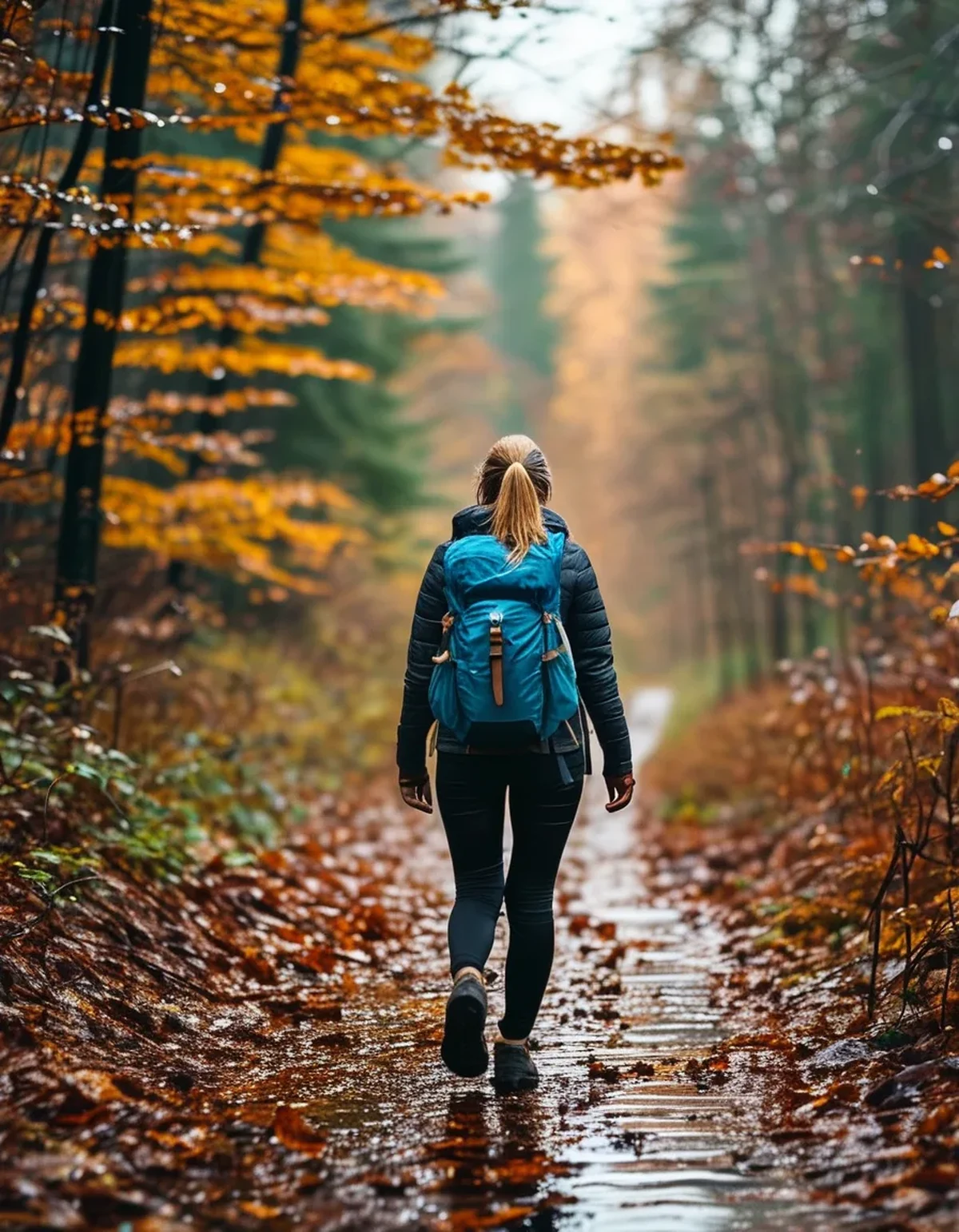
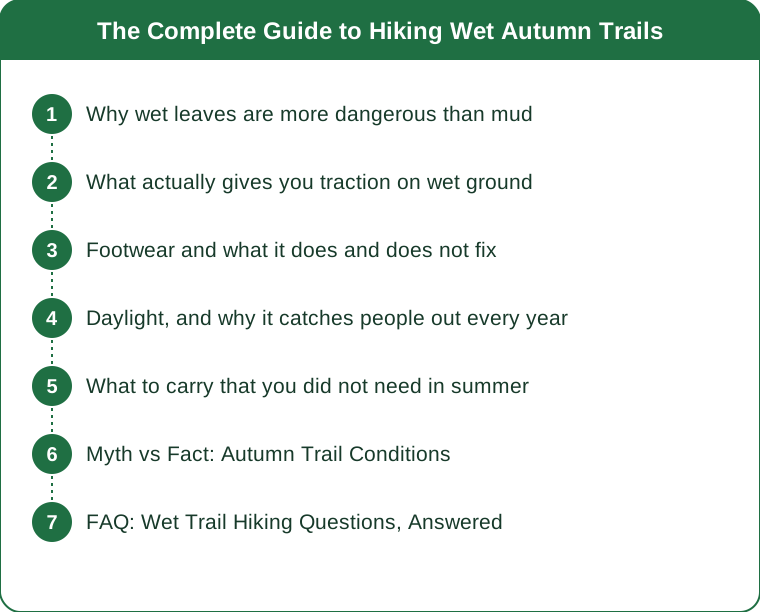
Why wet leaves are more dangerous than mud
This is the single most underestimated hazard of the season, and the physics is worth understanding.
Wet leaves act as a lubricated layer between your boot and the surface underneath. Your foot grips the leaf, and the leaf slides on the rock or packed soil below. No amount of lug depth helps, because the sole never contacts the actual ground.
Mud, by contrast, deforms under your foot. Lugs push into it and find purchase, which is exactly what aggressive tread is designed for. Mud is manageable with technique and appropriate footwear; wet leaves largely are not.
Leaves also hide what is underneath. A leaf layer conceals roots, loose rock, holes and drop-offs, so a slip on leaves frequently becomes an awkward landing rather than a controlled one.
They accumulate exactly where you least want them. Leaves collect in hollows, on the inside of switchbacks and at the base of descents — all places where you are already moving downhill and carrying momentum.
And they get worse over the first few weeks of leaf fall. A fresh dry leaf layer is relatively benign; the same leaves after a week of rain form a compacted, slick mat that behaves like wet paper on tile.
The practical response is to treat leaf-covered descents as ice: shorter steps, feet flat, weight centred, poles out, and speed reduced well before you think you need to.
What actually gives you traction on wet ground
Technique first, then equipment, in that order of importance.
Shorten your stride substantially. A short step keeps your centre of mass over your feet. A long step puts your weight behind your leading foot, and a leading foot that slips takes you backwards.
Increase your cadence to compensate. More, smaller steps maintains your pace while dramatically reducing the consequences of any individual slip.
Land flat-footed on descents rather than heel-first. A heel strike on a wet surface is the classic slip; a flat foot spreads the load and finds more contact area.
Keep your weight over your feet, not leaning back. The instinct on a slippery descent is to lean away from the slope, which reduces the downward force through the sole and makes slipping more likely, not less.
Use poles and plant them ahead. Two extra contact points genuinely change the stability equation on wet ground, and they are most valuable exactly where the hazard is highest.
Choose your line deliberately. Step on rock rather than leaves, on the textured part of a rock rather than the smooth, and on the uphill edge of a sloping surface.
And step over rather than on roots, painted rock and anything with a smooth, dark, slightly shiny appearance — that shine is usually algae or lichen, and wet lichen is among the most slippery natural surfaces there is.
Footwear and what it does and does not fix
Equipment helps, and it will not rescue poor technique on the worst surfaces.
Lug depth matters on mud and soft ground. Four to five millimetre lugs with wide spacing shed mud and bite into soft surfaces well; shallow lugs pack up and turn into slicks.
Rubber compound matters on wet rock. Softer, stickier compounds grip wet rock far better than hard-wearing ones. The trade is faster wear, which is a reasonable price for a shoulder-season shoe.
Nothing grips wet leaves reliably. This is worth stating plainly, because people buy footwear expecting it to solve a problem that footwear cannot solve.
Waterproof membranes keep water out and also keep it in. Once water comes over the cuff, a waterproof boot holds it. On a very wet day, a fast-draining non-waterproof shoe with wool socks is often the better choice.
Ankle support is a genuine consideration on hidden footing. With roots and rocks concealed under leaves, a mid or high cut reduces the consequences of an unexpected foot placement.
Microspikes are overkill for wet leaves and excellent for early frost. Autumn mornings above a certain altitude can produce genuine ice, and a light pair in the pack weighs very little.
And check your tread before the season. Worn lugs are the most common equipment factor in autumn slips, and the wear is gradual enough that most people do not notice it happening. Turn the boot over and look at the heel and the outside edge of the forefoot specifically — those wear first, and those are the parts doing the work on a wet descent. If the lug edges have gone rounded rather than square, the grip is already substantially reduced.
Socks matter more than people credit in wet conditions. Wool or a good synthetic keeps its structure and its warmth when saturated, while cotton holds water, loses all loft and starts generating blisters within a few kilometres. A spare pair weighs almost nothing and changes an entire afternoon.
Gaiters are worth more in autumn than at any other time. They keep leaf litter, grit and water out of the boot collar, and grit inside a wet boot is what turns a long descent into a blistered one. Short trail gaiters are light enough that there is no real reason not to carry them.
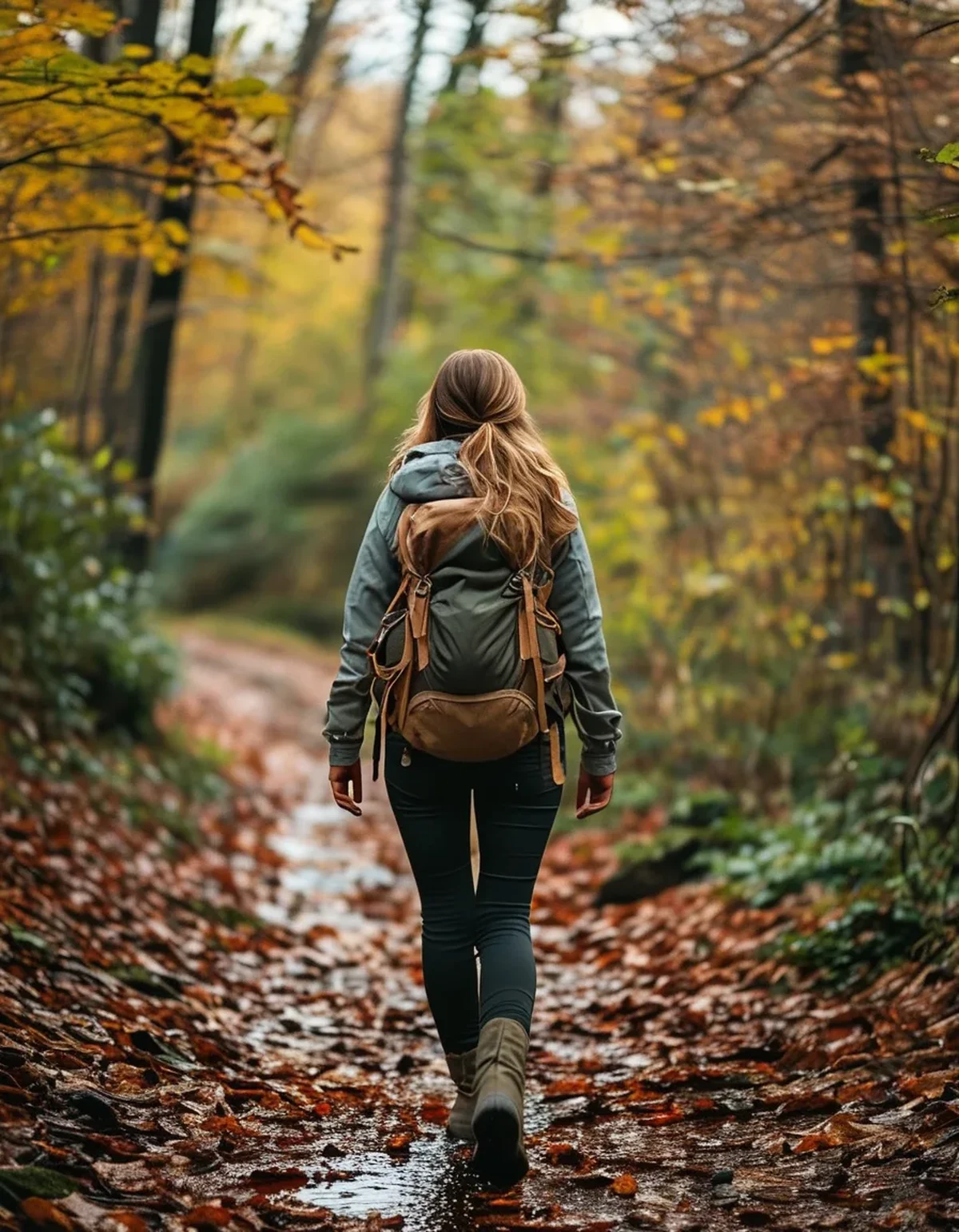
Daylight, and why it catches people out every year
The most consistent autumn planning error, and the easiest to fix.
Daylight shortens fast in autumn — several minutes per day at mid latitudes, which means a route you did comfortably in early September may not fit the same start time in late October.
Woodland goes dark well before sunset. Under tree cover, usable light can fail thirty to forty-five minutes before the official sunset time, and that is precisely where the wet leaf hazard is worst.
Wet conditions slow you down. Plan for twenty to thirty percent longer than your dry-conditions pace, more on technical descents.
Set a hard turnaround time and stick to it. Calculate backwards from sunset, subtract an hour of buffer, and subtract more for a descent on wet leaves.
Carry a headtorch, always, on every autumn hike. Not as an emergency item but as a planned one. The weight is trivial and the difference is total.
Descents take longer than expected in poor light, not shorter, because careful foot placement in a headtorch beam is slow work.
And tell someone your route and expected return. This is standard advice that becomes materially more important when the margin for error narrows.
Plan the descent, not the summit. Most people budget their day around reaching a high point and treat the way down as an afterthought. In autumn the descent is the slow, technical, low-light part of the day, and it deserves the larger share of the time budget. A useful rule is to allow the same time down as up on wet leaf-covered ground, rather than the two-thirds you would assume in summer.
Check the sunset time for the actual date, not the month. Late October and early October differ by a substantial margin, and a route you did three weekends ago now finishes in the dark from the same start time. Looking it up takes ten seconds and it is the single most useful piece of autumn planning there is.
What to carry that you did not need in summer
Six additions, none of them heavy.
A headtorch with fresh batteries, plus a spare set. The single most important autumn addition.
A warm insulating layer that stays in the pack, unused unless you stop. Wet plus stopped plus autumn temperatures is how mild hypothermia starts, and it starts faster than people expect.
Gloves and a hat. Extremities go first, and cold hands make everything else harder — including poles, zips and phone screens.
A dry pair of socks in a bag. Disproportionate comfort for very little weight, and genuinely important if conditions turn.
More food than the distance suggests. Cold weather raises energy expenditure, and a slower pace means longer on the trail.
And a paper map or offline maps downloaded. Shorter days plus unfamiliar leaf-covered trails plus a phone battery draining in the cold is a combination worth planning around.
One thing to leave behind: the summer assumption that you can extend the route if you are feeling good. In autumn, the daylight budget is the binding constraint, not your legs.
Myth vs Fact: Autumn Trail Conditions
Myth: Good boots solve wet trail traction. Fact: Footwear helps on mud and wet rock. On wet leaves, nothing grips reliably, because the sole never contacts the ground underneath. Technique and speed are the only real controls.
Myth: Leaning back on a slippery descent is safer. Fact: It reduces the force through your soles and puts your feet ahead of your centre of mass, which is precisely how slips become falls. Stay upright with weight over your feet.
Myth: Mud is the main autumn hazard. Fact: Mud is visible, expected and largely manageable. Wet leaves over hard-packed trail are more slippery, less obvious and hide the footing underneath.
Myth: Waterproof boots are always better in wet conditions. Fact: They are better until water comes over the top, after which they hold it. On genuinely wet days, fast-draining shoes with wool socks often keep feet warmer.
Myth: You will notice when it starts getting dark. Fact: Your eyes adapt gradually and woodland dims well before sunset. People routinely realise how dark it is only when it is already a problem, which is why a fixed turnaround time beats judgement.
Myth: Poles are for older hikers or long distances. Fact: Poles provide two additional contact points, which matters most on exactly the wet, uneven descents where autumn slips happen. They are a traction tool, not a mobility aid.
FAQ: Wet Trail Hiking Questions, Answered
Why are wet leaves more slippery than mud?
Because the leaf slides against the surface beneath it while your boot grips the leaf. Your sole never contacts the ground, so tread depth cannot help. Mud, by contrast, deforms and lets lugs find purchase.
What is the best footwear for wet autumn trails?
Deeper, well-spaced lugs for mud and a softer, stickier rubber compound for wet rock. Neither solves wet leaves. Check your existing tread before the season — worn lugs are the most common equipment factor in autumn slips.
How should I change my technique on wet descents?
Shorter steps, higher cadence, flat-footed landings, weight over your feet rather than leaning back, and poles planted ahead. Reduce speed before the steep section, not during it.
How much daylight buffer should I plan for?
Calculate backwards from sunset, subtract at least an hour, and add more for a wooded descent. Woodland goes dark thirty to forty-five minutes before official sunset, and wet conditions slow you by twenty to thirty percent.
TL;DR:
- Wet leaves are more dangerous than mud because your sole never touches the ground. Treat leaf-covered descents as ice.
- Technique beats footwear: shorter steps, higher cadence, flat foot, weight over your feet, poles planted ahead.
- Lug depth helps on mud, sticky rubber helps on wet rock, and nothing reliably helps on wet leaves.
- Woodland darkens well before sunset. Set a hard turnaround time and carry a headtorch on every autumn hike.
- Add a spare insulating layer, gloves, dry socks and extra food. Cold plus wet plus stopped is the real risk.
Autumn is the best hiking of the year, and the margin is smaller. Plan for the light and slow down on the leaves.
Keep Reading
This article is for general informational and styling purposes only. Fit, sizing, and product availability may vary — check current details before purchasing.