The Complete Guide to Planning an Autumn Hike Around Wind and Exposure
Quick Answer: Wind is the variable that turns a manageable autumn day into a dangerous one, and it’s the one most hikers don’t plan around. A 5 degree day with 40km/h wind has an effective temperature near freezing, and wind speed roughly doubles at ridge level compared with valley forecasts. Plan routes so exposed sections come early, carry a genuine windproof layer, and set a wind-speed turnaround threshold before you leave.
This is the full version: how wind behaves in terrain, how to read a forecast properly, how to plan a route around exposure, what to carry, and how to make the decision to turn back.

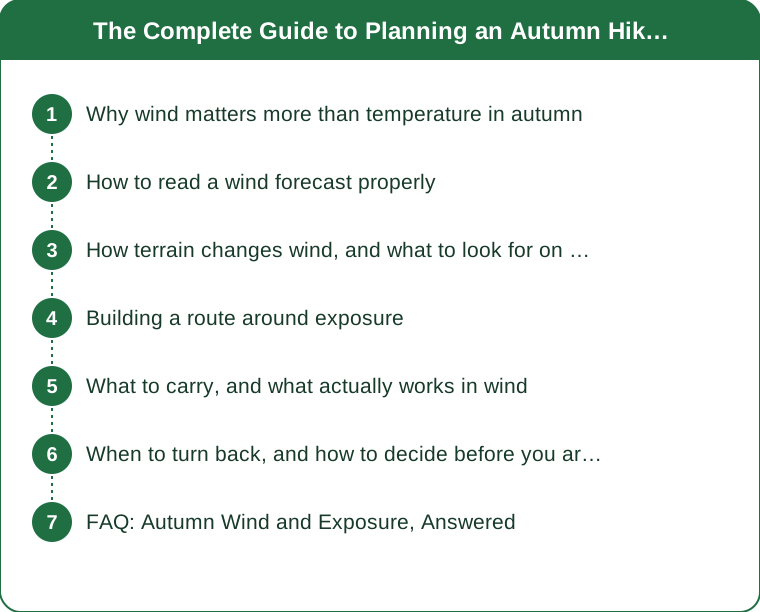
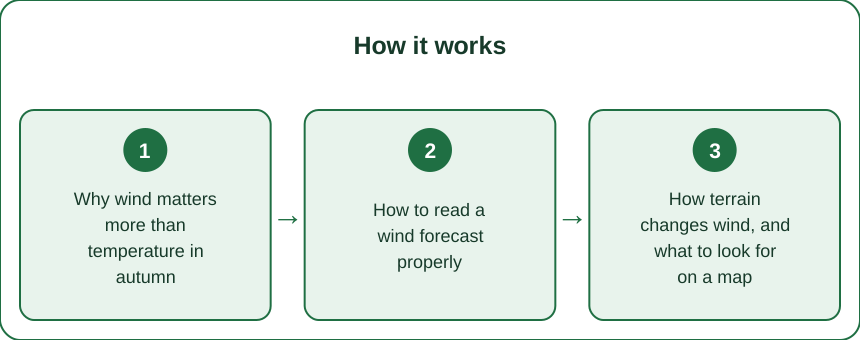
Why wind matters more than temperature in autumn
Because heat loss is driven by the rate at which your body’s warm boundary layer is stripped away, and wind is what strips it.
Still air next to your skin and inside your clothing forms an insulating layer. That layer is doing a large share of the work of keeping you warm, and it’s the reason a still 2 degree day is comfortable in a fleece. Wind removes it continuously, so your body has to keep reheating air that keeps being carried away.
The standard wind chill figures make the scale of it clear. At 5 degrees with no wind, you’re comfortable in a mid layer. At 5 degrees with 40km/h wind, the effective temperature is close to minus 2. At 0 degrees with 50km/h wind, it’s around minus 8.
Autumn is where this becomes dangerous specifically because the air temperature still reads as mild. People dress for the number on the forecast and get caught by the number that isn’t on it. In midwinter everyone over-prepares; in October a 6 degree forecast reads as a jumper day.
There’s a second mechanism that matters as much and gets less attention: wind drives evaporative cooling. If your base layer is damp with sweat from the climb, wind on a ridge evaporates that moisture and the latent heat comes out of you. This is why hikers get cold fastest at the moment they stop climbing and step onto an exposed section, which is precisely the most common accident sequence in autumn hill walking.
And a third: wind causes fatigue independent of temperature. Walking into a 40km/h headwind meaningfully increases the energy cost of movement, and constant buffeting degrades balance, which matters on uneven ground. A route that takes four hours in still conditions can take five and a half in strong wind, which pushes you into the shrinking autumn daylight.
How to read a wind forecast properly
Most hikers read the wrong number, from the wrong source, for the wrong altitude.
Valley forecasts underestimate ridge wind substantially. A general area forecast is typically modelled at or near ground level in the populated part of the area. Wind speed increases with height above ground and accelerates over terrain. As a working rule, expect wind at ridge level to be roughly double the valley forecast, and considerably more than that at a col or a summit.
Use a mountain-specific forecast where one exists. Services that publish forecasts by altitude band, typically at 900m, 600m, and valley level, are far more useful than a general weather app. They also publish wind direction, which is what lets you plan.
Read gust speed, not average. Average wind is what you walk in; gusts are what knock you over. A forecast of 30km/h averages with 70km/h gusts is a genuinely difficult day, and the average alone reads as unremarkable. As a rough guide, walking becomes awkward around 40km/h, difficult around 55km/h, and hazardous on exposed ground above about 65km/h, at which point being blown off balance is a real risk.
Note the direction, then look at your map. Direction determines which slopes are sheltered and which are being funnelled. A westerly wind means east-facing slopes and valleys give shelter, and any west-facing col will accelerate.
Check the freezing level too. In autumn it moves rapidly, and a forecast with a freezing level at 800m means anything above that could have ice, which changes the risk on an exposed section entirely.
Look at the trend, not the snapshot. Autumn systems move fast. A forecast that shows wind increasing through the afternoon means an early start is not just pleasant, it’s the plan.
How terrain changes wind, and what to look for on a map
Wind is not evenly distributed across a landscape, and the map tells you where it will be worst before you go.
Cols, saddles, and passes accelerate wind dramatically. Air moving across a ridge is forced through the low point, which compresses and speeds it. A col can carry wind at double the speed of the ridge either side of it. On a map, a col is where contour lines pinch inward between two summits, and it should be treated as the windiest point on any route.
Ridges are exposed on both sides and offer no bail-out. They’re also where the wind is closest to the unobstructed forecast speed. Long ridge sections are the highest-commitment part of any autumn route.
Lee slopes shelter, and they also collect. The downwind side of a ridge is calmer, and it’s where cloud, precipitation, and later in the season snow accumulate. Sheltered is not automatically safer.
Valleys can funnel. A valley aligned with the wind direction accelerates it along its length. A valley perpendicular to the wind shelters. This is why the same valley can be calm one weekend and unpleasant the next with no change in forecast speed.
Corries and bowls create rotor and eddy effects, where wind arrives from an unexpected direction and swirls. This is disorienting rather than dangerous in itself, and it matters if you’re navigating by feel.
Tree line matters enormously. Below the trees you’re in near-still air; above it you’re in full flow. The transition is abrupt, and it’s the point at which to put layers on rather than after you’ve walked into the wind for ten minutes.
Practically, this means taking five minutes with the map before you go, marking every col and every long exposed ridge section, and knowing where the tree line sits.

Building a route around exposure
The principle is straightforward: do the exposed parts when conditions and you are at your best, and have a way out of them.
Front-load the exposure. Autumn weather typically deteriorates through the afternoon, and daylight is shrinking. Doing the ridge at 10am and the sheltered valley return at 3pm is almost always better than the reverse, even if the reverse is the more logical circuit.
Plan the direction of travel relative to wind direction. Walking out into a headwind and back with a tailwind is far safer than the opposite, because you’re strongest at the start and the return leg is assisted. Getting this backwards is a common and serious planning error, since it means facing the hardest conditions when you’re tired.
Identify escape routes off every exposed section. For each ridge, know where you can descend into shelter and roughly how long it takes. A route with three bail-out points is a fundamentally different proposition from one with none.
Build in a shorter alternative before you leave. Not a vague intention. An actual mapped alternative with a decision point and a time attached: if we are not at the col by 12:30, we take the lower path.
Add time for wind. A conservative approach is to add 20 to 30 percent to your estimated time for a route with substantial exposure in strong wind. Then check that against sunset.
Check sunset and subtract an hour. Autumn daylight disappears faster than people plan for, and dusk on an exposed ridge in wind is where straightforward days become incidents.
Tell someone the plan and the alternative. Both, with times. If you take the shorter option, that’s information someone should have.
What to carry, and what actually works in wind
A genuine windproof shell is the single most important item, and it’s distinct from a waterproof, though most waterproofs are also windproof. What matters is that it’s fully windproof rather than water-resistant, that it has a hood that adjusts and stays up, and that the cuffs and hem close. A shell that flaps open at the hem is substantially less effective.
A hood that works with your head turned. Test it. Many hoods are effective facing forward and rotate off your head when you look sideways, which is exactly what you do while navigating.
Gloves, and a spare pair. Hands lose function before the rest of you feels cold, and a hand that can’t work a zip or a map is a genuine problem. Thin liner gloves under a windproof outer glove is more versatile than one thick pair.
A hat, and a buff or neck gaiter. Heat loss from the head and neck in wind is significant, and a buff also protects the face on an exposed section, which matters more than people expect.
A dry base layer in the pack. Changing a sweat-soaked base layer before an exposed section is one of the highest-value things you can do, and almost nobody does it because it means stopping and getting cold for two minutes.
Goggles or glasses if the wind is strong. Eye watering in strong wind degrades vision meaningfully on technical ground.
More food than you think. Cold and wind increase energy expenditure and appetite is suppressed in the cold, so it needs to be food you’ll eat without wanting it.
A group shelter if you’re in a party, or a bivvy bag if solo. Small, light, and the difference between an uncomfortable wait and a serious situation if someone is injured.
One principle that outranks the gear list: layer before you’re cold, and remove layers before you sweat. In wind, both mistakes are more expensive than in still conditions.
When to turn back, and how to decide before you are tired
The hardest part of this is that the decision has to be made by a person who is tired, invested, and has driven two hours to be there. So the decision should be made in advance, at home, by a person who isn’t.
Set a wind threshold before you go. Something like: if gusts are forecast above 65km/h at ridge level, the ridge is off and we do the valley route. Written down, agreed by the group.
Set a time threshold. If we are not at the summit by a given time, we turn round. This is the standard turnaround rule and it works because it removes judgement at the moment judgement is worst.
Set a condition threshold in observable terms. If we are being blown off our line of travel, if we cannot stand still on the ridge without bracing, if visibility drops below 50 metres, we go down. These are checkable, unlike how bad is this.
Recognise the specific warning signs. Struggling to walk in a straight line, needing to shout to be heard at close range, and being unable to face into the wind are all indicators that conditions are beyond straightforward walking. Fumbling with zips or being unable to manage the map are signs of cold affecting function, which precedes worse.
Understand the psychology. Sunk cost is powerful, group dynamics suppress dissent, and summit fever is real. The most common phrase in mountain incident reports is a variation of we were nearly there. Deciding in advance and stating the plan out loud to the group is the countermeasure.
Turning back early is a normal outcome. Autumn conditions change quickly and the hill will be there in a fortnight. The most experienced hikers turn back more often than beginners, not less, and it’s the clearest single marker of experience there is.
If someone in the group becomes uncoordinated, confused, unusually quiet, or stops shivering while still cold, that’s a medical emergency rather than a fitness issue, and it needs shelter, insulation, and a call for help. This is general information, not medical advice.
FAQ: Autumn Wind and Exposure, Answered
At what wind speed should I cancel a hike?
There isn’t a universal number, because it depends on terrain and the party. As a practical guide, gusts above 65km/h make exposed ridges hazardous for most people, and above 80km/h it’s not walking terrain regardless of experience. Below-treeline routes remain viable at speeds where ridges aren’t.
Is a waterproof enough or do I need a separate windproof?
Most hardshell waterproofs are fully windproof and will do both jobs. A dedicated lightweight windproof is worth carrying in addition because it’s more breathable for climbing in dry, windy conditions, and switching to it means arriving at the exposed section less sweaty.
How much does wind slow you down?
A sustained headwind above 40km/h can reduce pace by 20 to 30 percent on exposed ground, more if the terrain is uneven, because balance corrections cost energy. Plan the time accordingly rather than discovering it.
Why did I get cold so fast when I stopped?
Evaporative cooling from a damp base layer combined with wind stripping your boundary layer. Metabolic heat production drops the moment you stop climbing while heat loss increases, and the gap opens within a minute or two. Put a layer on before you stop, not after.
TL;DR:
- Wind, not temperature, is what makes autumn hiking dangerous: 5 degrees with 40km/h wind feels close to freezing, and ridge wind runs roughly double the valley forecast.
- Read gusts rather than averages, use altitude-band mountain forecasts, and check wind direction against the map for cols, ridges, and funnelled valleys.
- Plan exposed sections early, walk out into the headwind rather than back into it, mark escape routes, and add 20 to 30 percent to your time estimate.
- Carry a proper windproof with a working hood, spare gloves, a dry base layer, and a group shelter.
- Set wind, time, and condition thresholds at home, because the decision gets made by a tired version of you.
The skill in autumn hill walking is not enduring conditions, it’s planning around the variable that isn’t printed on the forecast. Confusion, uncoordination, or a cold person who stops shivering is a medical emergency, not a pace problem. This is general information, not medical advice.
Keep Reading
This article is for general informational and styling purposes only. Fit, sizing, and product availability may vary — check current details before purchasing.