The Complete Guide to Hiking in Autumn Fog and Low Cloud
Quick Answer: Autumn fog forms when warm moist air meets rapidly cooling ground, which is why it is most common on clear autumn mornings and in valleys and on hilltops. It removes the visual navigation you rely on without you noticing until you are already lost, and it soaks you slowly enough that you do not register getting cold. The core skills are navigating by bearing and distance rather than by landmark, knowing your escape route before you set off, and being willing to turn back early.
The forecast said clear.
You walked into cloud at four hundred metres and the path disappeared.
Everything you were navigating by is now fifteen metres away and grey.
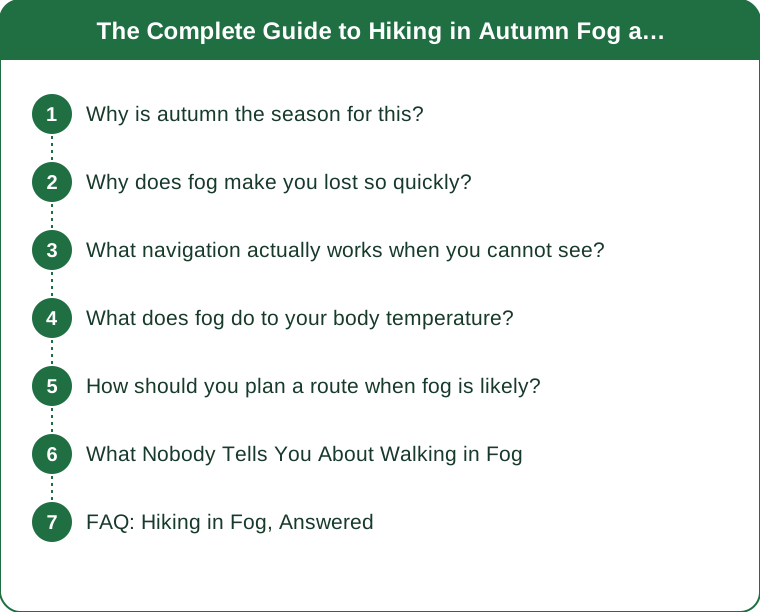
Why is autumn the season for this?
Because the specific conditions that form fog are exactly what autumn produces.
Radiation fog forms overnight when the ground cools quickly under clear skies and the air just above it cools below its dew point. Autumn provides long clear nights, ground that is still relatively warm and damp, and cool air — which is precisely the recipe. It is most common in valleys, where cold air pools.
Hill fog is different and more relevant to walkers. This is simply low cloud, formed when moist air is forced up over high ground and cools as it rises. It sits on the hill rather than forming in place, which is why you can walk out of clear conditions and into cloud at a specific altitude.
Autumn air carries more moisture close to the ground. Wet ground, decaying vegetation and recent rain all increase the humidity at low levels, which lowers the amount of cooling required for condensation.
And the temperature swing between day and night is at its largest in autumn. A twelve or fifteen degree drop overnight is common, which drives the morning fog that then burns off slowly — or does not burn off at all in a valley that sees no sun.
The practical consequence is that fog is far more predictable than it appears. A clear, still autumn night followed by a calm morning is a fog forecast, and hilltop cloud can be predicted from the cloud base figure in a mountain forecast. Both of these are available before you leave, and most people never look at them.
Which means the first skill is not navigation. It is checking, the night before, whether the conditions that produce fog are present — and planning the route accordingly rather than discovering it at four hundred metres.
Why does fog make you lost so quickly?
Because it removes the navigation method you did not know you were using.
Most walkers navigate by landmark and terrain association without consciously doing it. You look ahead, identify a feature, and walk toward it — the map is a confirmation rather than a primary tool. Fog removes every feature beyond your visual range, and that range can drop to a few metres.
Your sense of direction without visual reference is unreliable. People asked to walk in a straight line without visual cues consistently curve, and the curve is not something you feel. In fog you will drift, and you will be confident you have not.
Distance perception fails too. Without reference points, judging how far you have travelled becomes guesswork, and most people underestimate. This is why walkers in fog frequently overshoot a turning and then continue in the belief that it is still ahead.
Slopes become the only available information and they are ambiguous. Knowing you are going uphill does not tell you which hill or which side of it, and in featureless terrain the aspect of the slope may be all you have.
And it degrades gradually, which is the dangerous part. You do not walk into fog and become lost immediately — you continue confidently for ten or twenty minutes on accumulated error before anything feels wrong. By the time you notice, you have to reconstruct where the error started, which is far harder than avoiding it.
The countermeasure is to switch navigation methods before you need to, not when you realise you are lost. Once you are unsure of your position, every tool becomes harder to use.
What navigation actually works when you cannot see?
A specific set of techniques, and they need to be practised before the day you need them.
Bearing and distance replaces landmark navigation entirely. You take a compass bearing from the map, and you measure progress by counting distance rather than by looking for features. This is the core skill and it works when nothing else does.
Pacing is how you measure distance. Count your paces over a known hundred metres in advance, on flat ground and on a slope, and you have a personal conversion — most people are somewhere around sixty to seventy double paces per hundred metres. Knowing your own number turns distance from a guess into a measurement.
Timing is the backup for pacing. A known walking speed over known terrain lets you estimate distance from elapsed time, which is less precise than pacing and much easier to sustain over long legs.
Break the route into short legs with definite ends. A leg that ends at a wall, a stream, a path junction or a change of slope gives you a checkpoint you can confirm by feel rather than by sight. Long legs accumulate error; short legs bound it.
Use handrails and catching features. A handrail is a linear feature you follow — a wall, a fence, a stream, a ridge line. A catching feature is something across your path that tells you when you have gone too far — a track, a river, a change in gradient. Deliberately aiming slightly to one side of a target so you know which way to turn when you hit the catching feature is a standard technique and it is far more reliable than aiming directly at a point you cannot see.
GPS is excellent and is not a substitute for any of the above. Batteries fail in cold, screens fail when wet, and a device that tells you where you are does not tell you where to go. Carry it, use it, and carry a map and compass you can actually use.
What does fog do to your body temperature?
More than the thermometer suggests, and it does it without warning you.
Fog is suspended water and it wets you continuously. Walking through cloud soaks outer layers gradually rather than obviously, so there is no moment where you decide to put a waterproof on. By the time you notice, your insulating layer is damp.
Wet clothing loses most of its insulating value. Damp fabric conducts heat away from the body far faster than dry fabric, which is why a layer that was adequate at the car park is inadequate an hour into cloud at the same air temperature.
Wind on wet clothing is the dangerous combination. Evaporative cooling from wet layers in moving air removes heat rapidly, and hilltops in cloud are usually windy. This is the mechanism behind most hypothermia in temperate hill walking, and it does not require freezing temperatures.
You also stop moving as fast. Navigating carefully in poor visibility slows you down substantially, which reduces your heat production at the same time as your insulation is failing. Both curves move the wrong way together.
And the early signs are cognitive, which is why they get missed. Poor decision-making, clumsiness and reduced coordination appear before you feel dangerously cold — and in a group, noticing it in someone else is far more reliable than noticing it in yourself. Check on each other rather than on yourselves.
Practically: put the waterproof on when you enter cloud, not when you feel wet. Add a layer before the ridge, not on it, and eat regularly — thermoregulation burns energy and a low-fuel walker gets cold faster. This is general information, not medical advice.
How should you plan a route when fog is likely?
Around the possibility, so that the fog changes your day rather than ending it.
Check the cloud base figure, not just the general forecast. Mountain and hill forecasts give a cloud base height, and comparing it with the altitude of your route tells you in advance whether you will be walking in cloud. This single number changes the plan more than anything else on the forecast.
Plan a route you could navigate blind. Following a wall, a well-defined ridge, or a track is a completely different proposition in fog from crossing open moorland, and choosing the former on a doubtful day is not a compromise — it is the correct plan.
Decide your escape routes before you leave, and write them down. Knowing that a bearing of a specific direction from any point on the ridge takes you down into a valley with a track is the information you want to have already, not to work out in cloud.
Set a turnaround time and a turnaround condition. A time for daylight, and a condition for visibility — for example, if visibility drops below a set distance before a specific point, you turn back. Deciding this at the car is easy; deciding it on the hill is not.
Tell someone your route and your expected return. Standard advice and worth repeating specifically for poor visibility days, when a delay is much more likely.
And be more conservative than you would be on a clear day, deliberately. A route well within your ability in good visibility can be at the edge of it in cloud, because navigation becomes the limiting factor rather than fitness. The honest question is not whether you can walk the route — it is whether you can navigate it without seeing.
What Nobody Tells You About Walking in Fog
It is often beautiful and worth going for. Above a temperature inversion, walking out of cloud into sunshine with valleys full of white below is one of the best things autumn offers, and inversions are most common on exactly the clear, still mornings that produce valley fog. The fog is sometimes the reason to go, not the reason to stay home.
Fog distorts sound as well as sight. Sound carries oddly in fog and direction becomes hard to judge, so navigating toward a road noise or a stream you can hear is less reliable than it feels.
Your headtorch makes visibility worse, not better. Light reflects off water droplets straight back at you, which is why driving on full beam in fog fails. In darkness and fog, a dimmer light aimed low is more useful than a bright one aimed forward.
Distances feel much longer. Time passes strangely with no visual progress, and walkers routinely believe they have gone much further than they have. This is another argument for pacing over estimation.
Groups spread out and lose each other with startling speed. Fifteen metres of visibility means the back of a group can lose the front in seconds, and this is the most common way people get separated. Close up, count heads, and agree a stop-and-wait rule before you enter cloud.
And the ground is wetter than the sky suggests. Fog deposits moisture on rock, grass and boardwalk continuously, so traction is worse than a day without rain would imply. Wet rock and wet leaves under fog is the autumn combination that produces most slips — expect the ground to be slick even though it has not rained.
FAQ: Hiking in Fog, Answered
Should I just turn back when I hit cloud?
It depends entirely on the route and your navigation. On a well-defined path with handrails, walking in cloud is straightforward; on open ground it is a genuine navigational exercise. If you are not confident navigating by bearing and pacing, turning back is the right answer and not a failure.
Is my phone GPS enough?
It is genuinely useful and it should not be your only method. Cold drains batteries fast, screens are hard to use wet, and a dropped phone ends your navigation entirely. Carry a map and compass, and know how to use them before the day you need to.
How do I stop walking in circles?
Use a compass bearing and check it frequently, and use back bearings on features you pass. Without a compass, drifting is essentially guaranteed — this is a well-established human tendency rather than a personal failing.
What is the single most useful skill to practise?
Pacing. Count your paces over a measured hundred metres, on the flat and uphill, and remember the numbers. It takes ten minutes to learn and it converts distance from a guess into a measurement.
Does fog mean the day is ruined?
Often not. Fog frequently sits at a specific altitude band, so dropping a hundred metres can put you in clear air, and valley fog often burns off by mid-morning. A route with a lower alternative gives you a good day either way.
How do I recognise hypothermia in a companion?
Watch for stumbling, slurred or reduced speech, unusual irritability or apathy, and poor decisions. The person affected is usually the last to notice, which is why groups should check on each other. Get them out of the wind, into dry insulation, and take it seriously. This is general information, not medical advice.
TL;DR:
- Autumn produces fog reliably: long clear nights, damp warm ground, large temperature swings.
- Check the cloud base figure in a hill forecast — it tells you in advance whether you will be in cloud.
- Fog removes landmark navigation, which most walkers use without realising it.
- Switch to bearing, pacing and timing before you need to, not once you are unsure.
- Use handrails and catching features, and aim deliberately off to one side of your target.
- Fog soaks you gradually; put the waterproof on when you enter cloud, not when you feel wet.
- Wet layers plus wind on a ridge is the real hazard, and it does not need freezing temperatures.
- Groups separate in seconds at fifteen metres visibility — close up and agree a stop rule.
Plan a route you could navigate blind, and the fog becomes weather rather than an emergency.
Keep Reading
This article is for general informational and styling purposes only. Fit, sizing, and product availability may vary — check current details before purchasing.