The Complete Guide to Choosing and Fitting Hiking Boots for Autumn
Quick Answer: Autumn conditions change the requirements in four specific ways: wet ground demands better grip compound and lug spacing, more descent time makes heel hold critical, thicker socks change your fitting size, and colder feet mean circulation matters more than insulation. Fit for the sock you will actually wear, size for downhill toe clearance rather than standing comfort, and choose grip for wet rock and mud rather than dry trail.
The boots that were perfect in July give you black toenails in October.
Nothing changed about the boots. Everything changed about the ground.
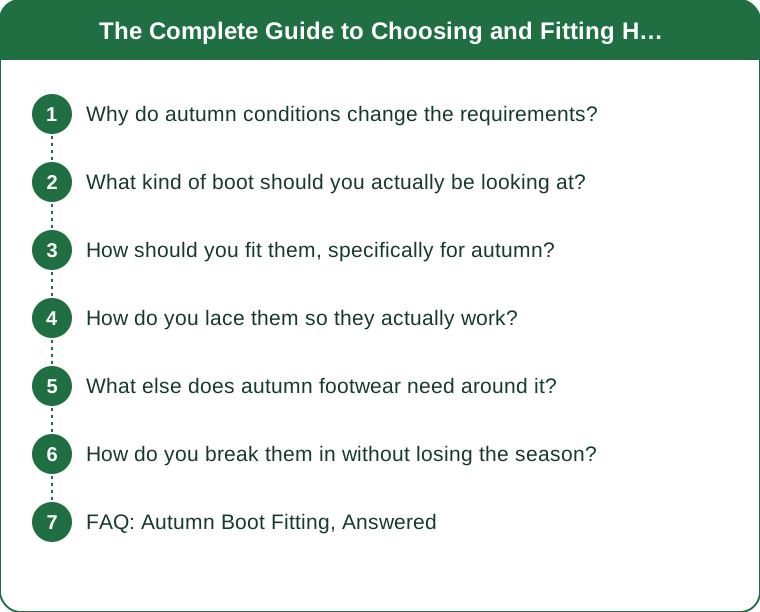
Why do autumn conditions change the requirements?
Because almost every variable that footwear has to handle moves at once, and they compound.
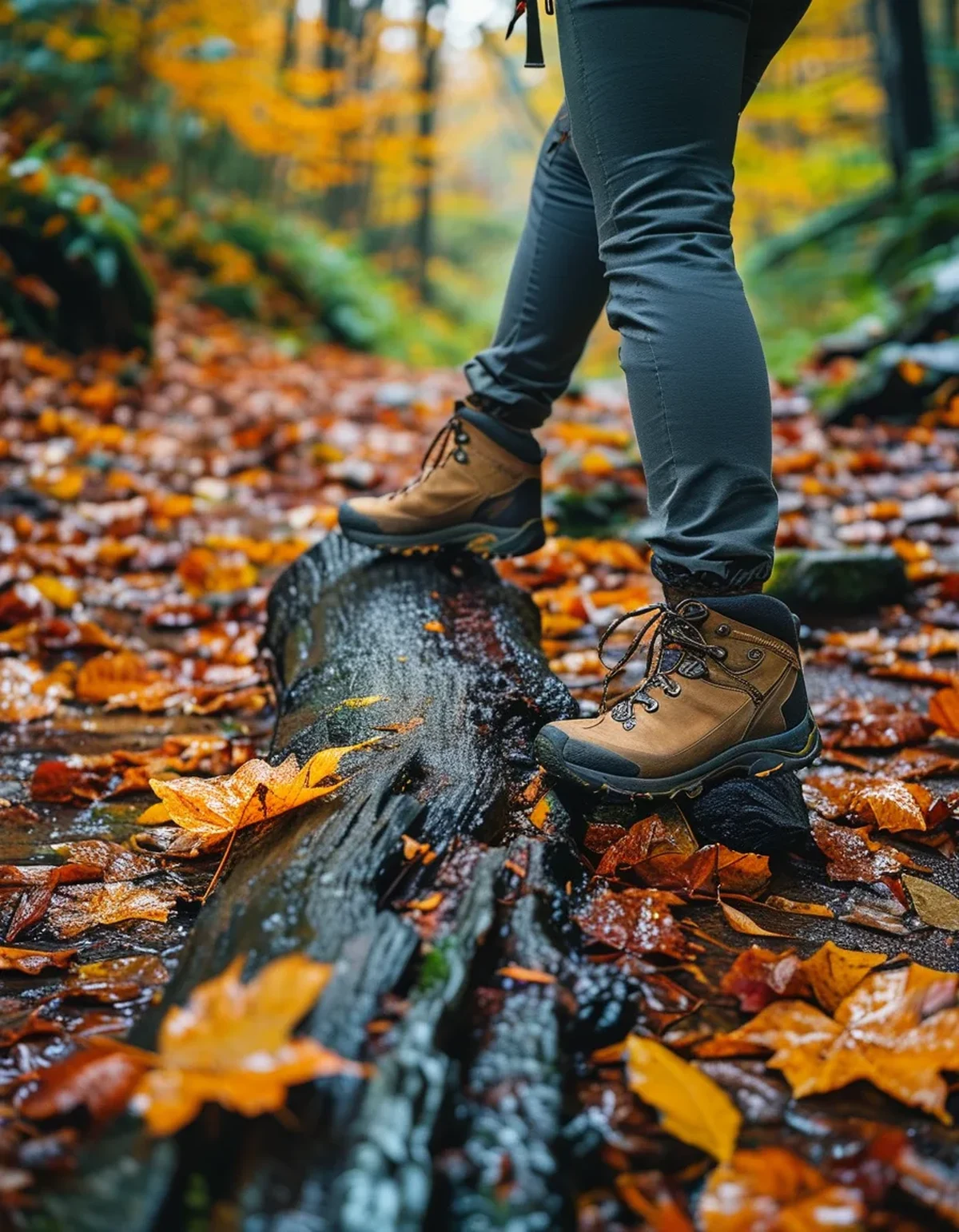
The ground gets wet and stays wet. Summer trails drain and dry between rainfall; autumn trails do not. Mud, wet rock, wet roots and wet leaves are all present simultaneously, and they demand different things from a sole. Wet rock needs a soft, sticky rubber compound with a large contact area. Mud needs deep, widely spaced lugs that shed rather than pack. Wet leaves over rock are among the most treacherous surfaces there is, because the leaf layer removes contact with the surface entirely.
Descents take longer and matter more. Shorter days mean more hikes finish in fading light, and tired legs on wet descents produce more braking, more toe contact with the front of the boot and more heel movement. Descent is where boots either work or reveal every fitting error you made.
Sock thickness changes. A midweight or heavyweight wool sock takes up meaningfully more volume than a summer liner — often enough to change your effective boot size by a half size. Boots fitted in August with thin socks are frequently too tight in November with proper ones, and a boot that is too tight is a circulation problem before it is a comfort problem.
Feet get cold, and cold feet come from compression more often than from insufficient insulation. This is the most misunderstood part of autumn and winter footwear. A boot laced tightly over a thick sock restricts blood flow, and restricted blood flow means cold toes regardless of how well insulated the boot is. The solution is almost always more room, not more insulation.
And water gets in from the top. Waterproof membranes handle rain and puddles; they do nothing about water entering over the cuff, which is what happens in deep mud, stream crossings and long wet grass. This is where gaiters stop being an affectation and start being the thing that keeps your feet dry.
What kind of boot should you actually be looking at?
It depends on terrain and load more than on season, and autumn nudges the answer in a particular direction.
Trail shoes and trail runners are light, breathable, dry quickly and offer excellent ground feel. In autumn they work well on established, well-drained trails and for anyone who accepts wet feet as normal and prioritises drying speed. They offer the least ankle support and the least protection from cold and wet, and on long muddy descents with a pack they can feel insufficient.
Mid-cut hiking boots are the mainstream answer for autumn day hiking, and for good reason. The higher cuff keeps out a reasonable amount of debris and shallow water, offers some ankle support on uneven ground, and provides more warmth. This is the category most people should be looking at for autumn day hikes with a light pack.
Full backpacking boots with stiffer midsoles are for heavy loads and sustained rough ground. The stiffness that supports a 15kg pack over rock is unnecessarily rigid for a day hike, and rigidity that is not needed is simply fatigue.
On waterproof membranes: they are genuinely useful in autumn, and they are a trade-off. A membrane keeps water out and also slows moisture escaping, so feet get damper from sweat than in a breathable non-membrane boot. In cool wet autumn conditions the trade favours the membrane; in warm conditions it does not, which is why the same boot can feel excellent in October and unpleasant in July.
On sole compound: this is the specification most worth caring about and the one least often examined. Softer rubber compounds grip wet rock dramatically better and wear out faster; harder compounds last longer and are noticeably worse on wet surfaces. For autumn, prioritise grip. Vibram Megagrip and comparable compounds from other manufacturers are specifically formulated for wet performance and are worth seeking out by name.
On lug pattern: deeper, more widely spaced lugs shed mud; shallow closely-spaced lugs pack up and become slicks. A clear heel brake — a defined edge at the rear of the sole — matters enormously on wet descents.
How should you fit them, specifically for autumn?
With the socks you will wear, at the end of the day, and with the descent in mind rather than standing comfort.
Bring your actual hiking socks. This is the single most important instruction and the one most often ignored. A midweight wool sock changes the fit meaningfully, and fitting in a thin sock and buying a boot that fits perfectly is how people end up with boots that are too small for the season they bought them for.
Fit in the afternoon or evening. Feet swell over the course of a day, and they swell more over the course of a hike. A boot fitted first thing in the morning to a tight, comfortable fit will be uncomfortable at hour five.
Check toe clearance with the heel back. Slide your foot forward until your toes touch the front, and you should be able to fit a finger — roughly 1-1.5cm — behind your heel. This is the space your toes need on a descent, and its absence is the single most common cause of black toenails and bruised toes.
Test on a slope. Any decent outdoor shop has an incline board. Walk down it. Your heel should stay put and your toes should not slam forward. If your foot slides on a two-metre ramp, it will slide for four hundred metres of descent.
Check heel lift while walking. A small amount of lift, a few millimetres, is normal and acceptable. Noticeable lift means blisters, and it is usually a shape mismatch rather than a size problem — the boot is the wrong volume or the wrong heel width for your foot, and a different model will fix what a different size will not.
Check the width across the ball of the foot. Pressure at the widest part is a fit failure that no lacing technique will solve. Many manufacturers offer wide fittings and most people do not know to ask.
Consider going up a half size for autumn and winter if you use the same boots year-round with different socks. Many experienced hikers do exactly this, running a summer boot and a winter boot a half size apart.
And take the insole out and stand on it. Your foot should sit within the outline with a small margin at the toe and no overhang at the sides. It is a crude test and it identifies a badly wrong boot in five seconds.
How do you lace them so they actually work?
Lacing is the most underused adjustment in hiking footwear, and it addresses several problems that people otherwise try to fix by buying different boots.
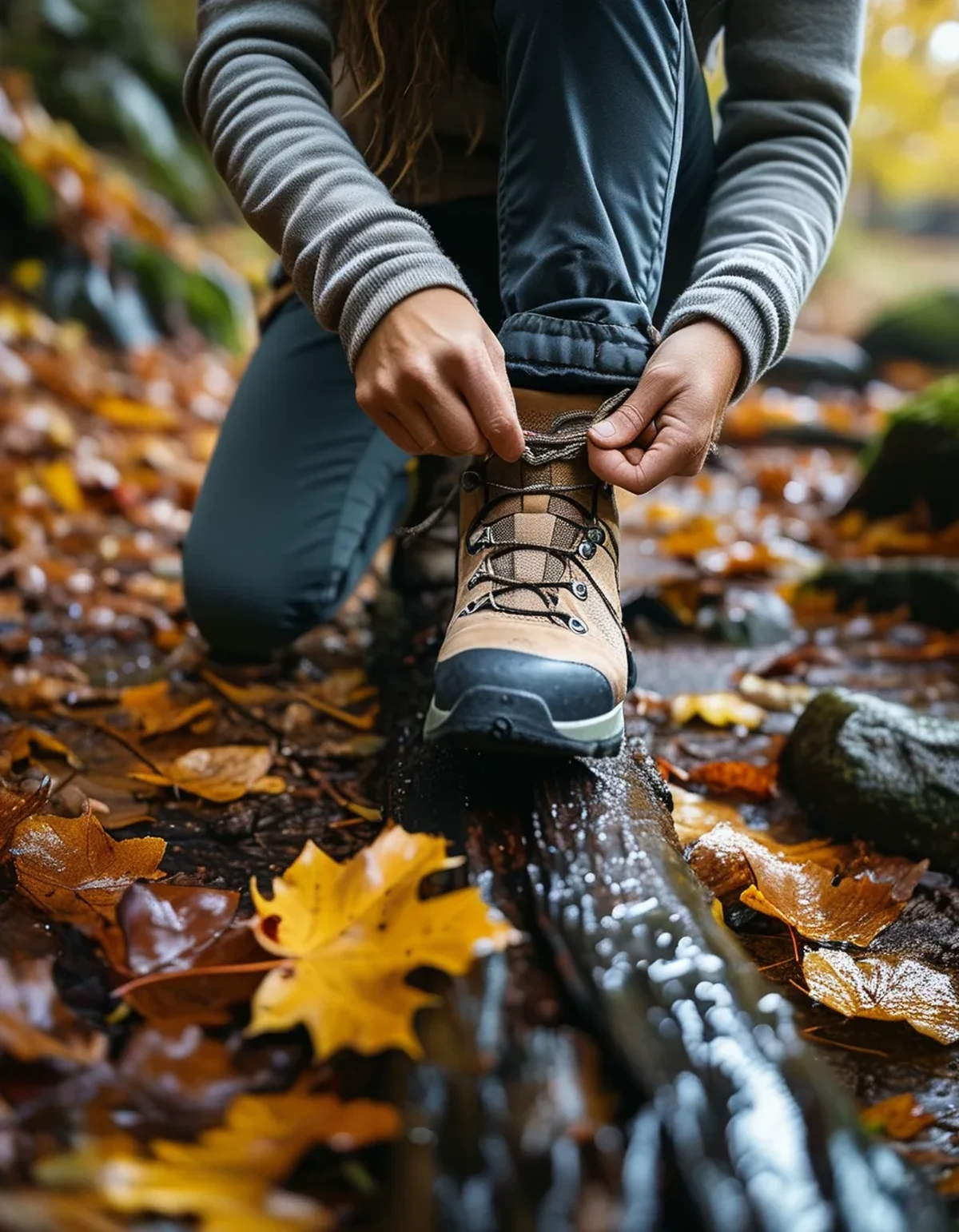
The basic principle: the forefoot and the ankle are separate zones and should be tensioned separately. Most boots have a lace hook or eyelet at the flex point that allows you to lock the tension between the two. Use it.
For descents, tighten the ankle and leave the forefoot looser. This is the key autumn technique. Heel lock lacing — a surgeon’s knot at the ankle hooks, or the loop-back method through the top two hooks — holds the heel firmly in the heel cup so your foot cannot slide forward, while the forefoot stays roomy enough for the toes and for circulation. This one technique prevents most black toenails.
For ascents, the reverse. Looser at the ankle to allow flexion, firmer through the midfoot. Many hikers relace at the top of a climb, and the two minutes is well spent.
Window lacing for pressure points. If you have a spot on the top of your foot that hurts — very common with a high instep — skip the crossing over that area and run the laces straight up the sides. It removes the pressure entirely.
Do not lace tightly to fix heel lift. It is the instinctive response and it produces cold feet, pressure on the top of the foot and no actual improvement in heel hold, because heel hold comes from the heel cup shape rather than from lace tension. Heel lock lacing, a thicker sock or a different boot are the actual fixes.
Retie during the hike. Laces settle, feet swell, and terrain changes. A hike with no lace adjustment is a hike where the lacing was wrong for most of it.
And replace laces before they break, ideally carrying a spare. A broken lace at the top of a wet descent is a genuinely serious problem, not an inconvenience.
What else does autumn footwear need around it?
The boot is one part of a system, and the rest of the system matters more in autumn than in summer.
Socks are the highest-value item. Merino wool or a wool blend, midweight for most autumn day hiking, and never cotton. Wool retains warmth when damp, manages moisture, and resists odour. The single most common gear upgrade that transforms people’s experience is switching from cotton to wool socks, and it costs very little.
Carry a spare pair. Dry socks at lunch on a wet hike is a genuine and disproportionate improvement, and dry socks in the pack is a safety item on a cold day.
Gaiters, which are underrated. Low gaiters keep mud, grit and water out of the boot top and stop wet trouser legs wicking down into the boot. On a muddy autumn trail they are the difference between wet feet and dry ones, and they cost less than most people expect.
Waterproof trousers or at least quick-drying ones. Wet legs deliver water directly into the boot cuff, which defeats any membrane.
Trekking poles matter more in autumn than in summer. They reduce load on the knees during descent by a meaningful amount, and on wet ground they provide two extra points of contact at exactly the moments when the footing is least reliable. On slippery descents they are a safety item.
Boot care becomes relevant. Waterproof membranes lose effectiveness when the outer fabric wets out, and reproofing with a suitable treatment restores it. Clean mud off after each hike — dried mud abrades the fabric and holds moisture against it — and dry boots slowly, away from direct heat. A radiator or a fire will damage adhesives and crack leather, and it is the fastest way to ruin a good pair.
And know when boots are finished. Compressed midsoles, worn-down lugs and a sole that no longer grips are not repairable. The tread is the visible indicator; the midsole is the one that quietly stops supporting you and produces foot and knee aches that get blamed on the trail.
Practical safety note: autumn hiking means shorter days, and the single most common cause of trouble is finishing later than planned. Carry a head torch on every autumn hike, even short ones, tell someone your route, and check the forecast for the summit rather than the car park.
How do you break them in without losing the season?
Gradually, deliberately, and starting sooner than you think.
Modern boots need less breaking in than traditional ones, and they still need some. Synthetic and fabric boots are largely ready after a few walks; full-leather boots genuinely need weeks.
Start indoors. Wear them around the house for a few evenings with your hiking socks. If a problem is going to appear, it appears here at zero cost, and you can still return them.
Then short local walks, an hour or two on easy ground. Then a longer walk with a pack. Then the hike you bought them for.
Include some descent in the break-in. A break-in that is all flat walking tells you nothing about the fitting variable that matters most. Find a hill.
Do not break in new boots on a big day. The classic error is buying boots for a specific trip and first wearing them properly on that trip. Blisters on day one of a three-day walk is a genuinely miserable and entirely preventable situation.
Address hot spots immediately. A hot spot is a blister that has not happened yet. Stopping to tape it, adjust lacing or change socks takes three minutes and prevents an injury that will affect the rest of the day and possibly the next.
Carry blister tape regardless, and know how to use it before you need it.
Buy them now rather than in December. Autumn is when the range is fullest and the stock is deepest, and it gives you the weeks of break-in before the conditions get serious. Buying boots in the week you need them is how people end up with whatever was in stock in roughly the right size, which is the origin of most bad boot experiences.
FAQ: Autumn Boot Fitting, Answered
Should I size up for thick socks or buy a bigger boot?
Size for the sock you will actually wear most, and check that the boot still holds your heel at that size. Sizing up without checking heel hold produces a boot that slides, which is worse than one that is slightly snug. If sizing up loses your heel, the boot is the wrong shape for your foot and a different model is the answer.
Are waterproof boots worth it if my feet get wet anyway?
In autumn, generally yes. Most autumn wetness is rain, dew, puddles and mud, all of which a membrane handles well. The scenario where a membrane loses is repeated stream crossings or sustained hot weather, where a fast-draining non-waterproof shoe is genuinely better. For typical autumn day hiking, the membrane wins.
How long should a pair of boots last?
With regular use, roughly 800-1,600km depending on terrain and construction, and the midsole usually fails before the upper looks worn. If your feet, knees or lower back have started aching on hikes that never used to be a problem, check the boots before concluding it is you.
Can I resole hiking boots?
Quality boots with a stitched or cemented construction from a manufacturer that supports it, yes — and it is worth doing on a well-fitting pair, since fit is the hard part to replace. Most mid-range boots are not economically resoleable, which is worth knowing at the point of purchase if longevity matters to you.
Are two pairs actually necessary?
Not necessary, and genuinely useful if you hike year-round: a lighter, breathable pair for summer and a roomier, grippier pair for autumn and winter with thicker socks. It also lets each pair dry fully between hikes, which extends the life of both considerably.
TL;DR:
- Autumn changes four things: wet ground needs a stickier compound and wider lugs, descents demand heel hold, thicker socks change your size, and cold feet come from compression rather than poor insulation.
- Mid-cut boots with a wet-rock rubber compound and a clear heel brake are the right default for autumn day hiking.
- Fit with your real socks, in the afternoon, with a finger’s width behind the heel — and test it on a slope before buying.
- Learn heel lock lacing: tight at the ankle, loose at the forefoot for descents. It prevents most black toenails.
- Merino socks, a spare pair, low gaiters, poles and a head torch are the rest of the system; break boots in over weeks and buy them now rather than in December.
Almost every autumn boot complaint traces back to one of two things: a fit assessed standing still in summer socks, or a sole compound chosen for a dry trail. Both are decided in the shop, in about ten minutes, and both are much easier to get right than to live with.
Keep Reading
This article is for general informational and styling purposes only. Fit, sizing, and product availability may vary — check current details before purchasing.