The Complete Guide to Deciding When to Turn Back on a Hike
Quick Answer: Set a turnaround time before you start — the clock time at which you head back regardless of how close the summit is — and add three condition triggers: weather deteriorating faster than forecast, any group member showing a genuine problem, and terrain that requires skills or gear you did not bring. Experienced hikers turn back more often than beginners, not less, and they decide earlier because they decided in advance.
Almost every difficult day in the hills has the same shape. Not a dramatic mistake — a series of small, reasonable decisions to keep going, each of which made sense on its own.
The skill is not toughness. It is having decided the rules before your judgment got tired.

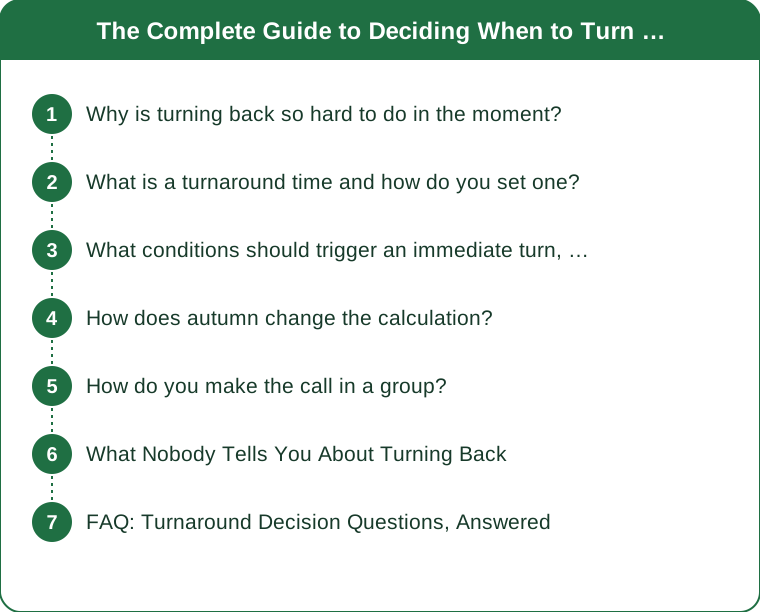
Why is turning back so hard to do in the moment?
Because every psychological force in play is pushing forward, and none of them are pushing back.
Sunk cost. You have already walked three hours. Turning back means those hours produced nothing, which the brain treats as a loss even though the hours are spent either way. This is the strongest of the forces and the least rational.
Goal proximity. The closer you get to a summit, the more motivated you become — the effect intensifies as the target nears. Unfortunately the last section of a route is usually the most exposed, the most technical, and the furthest from help. Motivation peaks precisely where the margin is thinnest.
Group dynamics. Nobody wants to be the person who ended the day. In a group of four, each person can privately think they should stop and assume everyone else is fine. This is the mechanism that puts groups in worse positions than any individual member would choose alone.
Fatigue-driven judgment. Decision quality degrades measurably with physical fatigue, dehydration, and low blood sugar. By the time the decision matters most, you are least equipped to make it. This is the single strongest argument for pre-committing.
Weather optimism. People consistently read deteriorating conditions as temporary. A cloud building is interpreted as a cloud that will pass, because that reading permits continuing.
None of this is a character flaw. It is how everyone’s brain works under those conditions, which is why the answer is a rule rather than resolve.
What is a turnaround time and how do you set one?
A turnaround time is a clock time, decided before you leave, at which you head back regardless of where you are. Not a distance, not a landmark. A time.
To calculate it, work backwards from when you need to be at the car:
- Find the time you must be off the trail. In autumn this means sunset minus a real buffer. Full darkness arrives roughly 30 minutes after sunset and usable light goes sooner in a valley or under tree cover. Take sunset and subtract 90 minutes.
- Estimate the descent honestly. Most people descend at 70 to 80 percent of the time it took to ascend — not half, which is the common assumption. On wet autumn ground with leaf cover, it can equal the ascent time.
- Add a contingency. Twenty percent minimum. This absorbs a navigation error, a blister stop, or a slower group member.
- Subtract from your must-be-off time. That is your turnaround.
A worked example. Sunset at 7:30pm. Off-trail target 6:00pm. Ascent has taken 3 hours so far and you expect 45 minutes more to the top; descent estimated at 2 hours 30, plus contingency, call it 3 hours. Turnaround is 3:00pm. If it is 3:00pm and the summit is twenty minutes away, you turn around — and this is exactly the scenario where people do not.
Write it on your hand or set a phone alarm. A turnaround time you have to remember is a turnaround time you will renegotiate.
What conditions should trigger an immediate turn, regardless of time?
Four, and they override the clock entirely.
Weather deteriorating faster than forecast. The specific trigger is not bad weather, which you may have planned for — it is weather arriving earlier or stronger than predicted. That means the forecast was wrong, and if it was wrong about timing it may be wrong about severity. Cloud dropping onto a ridge, wind rising noticeably in under thirty minutes, or temperature falling while you are still climbing are all reasons to reassess immediately.
Anyone in the group is genuinely struggling. Not tired — everyone is tired. The markers are: stopping to rest more often than every fifteen minutes, stumbling on ground they handled fine an hour ago, becoming quiet after being talkative, or getting cold and not warming up when moving. Any of those means the group’s capacity has changed, and everything downstream is now harder.
Terrain requiring skills or gear you do not have. Unavoidable exposure, a scramble beyond your group’s ability, a stream crossing that is running higher than expected. The rule is simple and hard: if you would not be comfortable doing it on the way back when tired, do not do it on the way up. Descending is technically harder than ascending on almost everything.
Navigation uncertainty. If you are not confident where you are, the priority is to re-establish position, not to make progress. Continuing while unsure is how a long day becomes a rescue. Backtracking to a known point is almost always the right call, and it is almost never the tempting one.
Any one of these is enough. They are not a scoring system.

How does autumn change the calculation?
More than any other season, and in several directions at once.
Daylight shrinks fast. Through September and October, daylight is disappearing at roughly two to three minutes a day in mid-latitudes. A route you did comfortably four weeks ago now has 90 fewer minutes of light. People plan from memory and memory does not update for the calendar.
Descents are slower. Wet leaves over rock and roots reduce traction dramatically, and leaf cover hides both the trail and what is on it. A descent that took two hours in August can take three in late October.
Temperature drops sharply after sunset. The difference between 4pm and 6pm can be 8 to 10°C in clear autumn conditions, and more on a ridge. A group that is warm while moving becomes cold within fifteen minutes of stopping.
Weather windows are shorter and less stable. Autumn systems move faster than summer ones. A forecast that is accurate at 9am can be wrong by 2pm in a way that a settled summer forecast rarely is.
Fewer people on the trail. Later in the season means fewer other parties, which means the informal safety net of other hikers is thinner. Do not count on someone coming along.
The practical adjustment: set your autumn turnaround earlier than feels necessary, and re-check sunset time for the actual date rather than relying on what it was last month.
How do you make the call in a group?
Structure it before you leave, because in the moment the dynamics work against you.
Agree the rules at the trailhead. Two minutes: here is the turnaround time, here are the conditions that end the day, and anyone can call it without justification. Getting explicit agreement while everyone is fresh removes the social cost later.
Give everyone an unquestioned veto. The single most effective group safety practice. If any member says they want to turn back, the group turns back, no debate and no explanation required. This removes the pressure that stops people speaking up — most incident reports include someone who was uncomfortable and said nothing.
Check in at the halfway point. A deliberate stop where you ask each person how they are doing, and use their own words rather than a nod. Someone who says fine while sitting down heavily is giving you information.
Watch the quiet one. The person who has stopped chatting is often the person struggling. Groups reliably miss this because they are watching the person complaining, who is usually fine — complaining takes energy.
Decide before you are tired. Everything above works because it is set up when judgment is good. A group that has not discussed any of this at 3pm on a cold ridge will do the thing that requires no decision, which is to keep walking.
What Nobody Tells You About Turning Back
Experienced hikers turn back more often, not less. It looks like the opposite from outside, because they also attempt harder things. But the habit of calling it early is what allows the harder attempts. Reading turning back as a failure gets the causality exactly backwards.
The decision gets harder the closer you get, not easier. Most people imagine the choice as clearest near the top. It is the least clear point on the whole route, because motivation is highest, fatigue is highest, and remaining distance looks smallest. If you have a turnaround time, you never have to make the decision there.
Descending is where most incidents happen. Fatigue, gravity, and reduced concentration all compound. A group that arrives at the summit with nothing in reserve has the harder half still ahead, and that is the half that hurts people.
Turning back rarely feels justified afterwards. You will not find out what would have happened. That absence of confirmation is why people keep going next time. Judge the decision by whether it was right with the information you had, not by an outcome you never saw.
Almost nobody regrets it a week later. The summit will still be there, and the route is often better in different conditions anyway. What people remember is the day they got caught out.
This is general information, not a substitute for training or local knowledge. Conditions vary enormously by region and season, and mountain skills courses are worth the money if you hike regularly.
FAQ: Turnaround Decision Questions, Answered
How do I set a turnaround time on a route I have never done?
Use a planning estimate — Naismith’s rule and its variants give roughly one hour per 5km plus an extra hour per 600m of ascent — then add 25 to 50 percent for an unfamiliar route, group size, and autumn ground. Set the turnaround from that conservative figure. You can always revise it forward once you see how the group is moving; revising it backward under pressure is what you are trying to avoid.
What if turning back means missing the whole point of the trip?
That is worth naming honestly at the planning stage, because a trip built around a single non-negotiable objective is a trip with poor decision-making built into it. Give yourself a genuine alternative — a lower route, a different viewpoint, a shorter loop — so the day still has a shape if the main plan ends. Options make turning back cheap.
Should I still turn back if the weather looks like it might clear?
If conditions arrived earlier or stronger than forecast, treat the forecast as unreliable and act on what you can see. Waiting to find out costs you daylight either way, and the cost of being wrong in one direction is a shorter walk while the cost in the other direction is considerably higher.
Is it safer to push on to a hut or descend the way I came?
Generally the known route wins, because you have already seen the ground and you know how long it takes. Continuing to an unseen destination trades a known quantity for an unknown one at exactly the moment your margin is thinnest. Exceptions exist — a genuinely shorter descent on a well-marked path, a hut you have used before — but they should be exceptions you identified during planning, not discoveries you make while tired.
TL;DR:
- Set a turnaround time before you leave, calculated backwards from being off the trail 90 minutes before sunset.
- Descents take 70 to 80 percent of ascent time, longer on wet autumn ground — most people badly underestimate this.
- Four overrides beat the clock: weather ahead of forecast, a struggling group member, terrain beyond your kit, and any navigation doubt.
- Give every group member an unquestioned veto, and check in at the halfway point using their own words.
- Autumn removes two to three minutes of daylight a day, so a route you did last month has meaningfully less light now.
Write your turnaround time on your hand before you set off. It is the only decision on the whole route you can make while your judgment is at its best.
Keep Reading
This article is for general informational and styling purposes only. Fit, sizing, and product availability may vary — check current details before purchasing.