The Complete Guide to Hiking in the Autumn Transition
Quick Answer: Autumn hiking is about margin management. Daylight shrinks by roughly two minutes a day, temperatures swing widely between valley and ridge, and wet leaves plus early frost make familiar ground genuinely slippery. Plan with a hard turnaround time, carry a layering system rather than one warm coat, always pack a head torch, and treat the descent as the risky part.
The colours are the best of the year.
So is the walking temperature.
And the margin for error is the smallest it has been since spring, which is what catches people out.
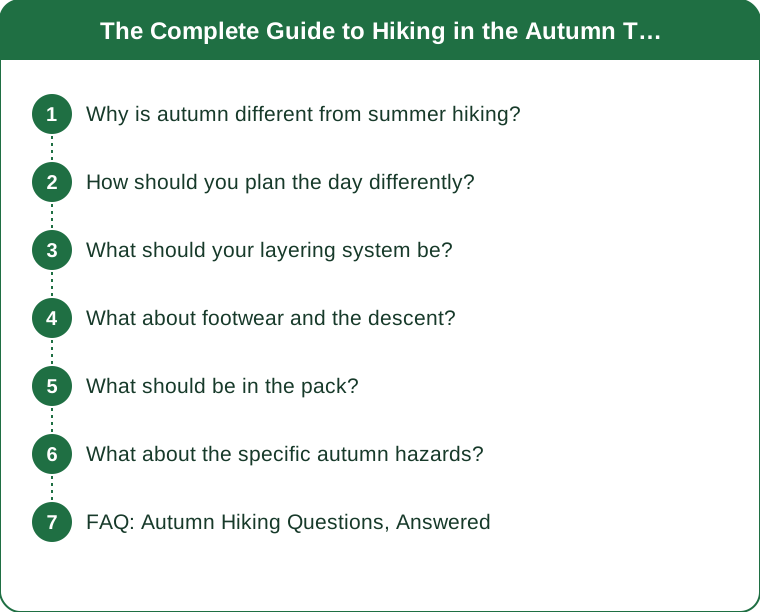
Why is autumn different from summer hiking?
Six changes, and they compound rather than sitting independently.
Daylight disappears fast and accelerates. In temperate latitudes you lose roughly two to three minutes of daylight per day through September and October, which compounds to more than an hour a fortnight. A route that finished comfortably in daylight three weeks ago now finishes in dusk, and most people plan from memory rather than from a current sunset time.
Temperature swings are much wider. Valley temperature at 10am and ridge temperature at 2pm can differ by 10-15C, and add wind chill on an exposed summit and the effective difference is greater still. Summer’s forgiving margins are gone.
Wet leaves are genuinely slippery. A layer of wet fallen leaves over rock or roots has very low friction, and it hides what is underneath. This is the most underestimated hazard of the season and the cause of a large share of autumn ankle injuries.
Early frost appears on high ground first. Ground that was merely wet at the car park can be frozen on a shaded ridge, and black ice on rock is very hard to see.
Weather changes faster. Autumn weather systems move quickly, and a forecast checked the night before can be substantially wrong by afternoon. Check again in the morning.
And conditions underfoot get wetter overall. Ground that drained in summer holds water in autumn, so paths that were firm become boggy and slower. Budget more time for the same distance — commonly 20-30 percent more on soft ground.
How should you plan the day differently?
Six planning decisions that create the margin you need.
Look up today’s actual sunset time, not your memory of it. Then set a hard turnaround time at least 90 minutes before sunset, and honour it regardless of how close the summit is. This single discipline prevents most autumn epics.
Start earlier than feels necessary. An hour earlier at the start is worth two hours at the end, because the hour at the start is in daylight and the hour at the end is not.
Choose routes with escape options. A route with a lower alternative or a shorter loop lets you adjust when the weather turns or you are slower than planned. Out-and-back routes with a single long return are the least forgiving.
Budget more time than the summer version of the route took. Soft ground, wet leaves and shorter steps on slippery descents all add time. Add 20-30 percent over your summer pace on the same route.
Check the forecast the morning of, and check wind specifically. Wind chill on an exposed ridge is what turns a manageable day into a serious one, and wind is the variable most people skip.
Tell someone your route and expected return time. Basic, frequently skipped, and it is the thing that matters if something goes wrong on a trail with fewer people on it than in summer.
What should your layering system be?
Six layers and principles, because a single warm coat does not work in autumn.
Base layer: synthetic or merino, never cotton. Cotton holds moisture against your skin and becomes actively dangerous when you stop moving in cold air. This is the least negotiable item on the list.
Mid layer: fleece or light insulated, easily removable. You will take this on and off repeatedly. Something you can remove without taking off a pack is worth a great deal.
Outer shell: waterproof and windproof, with a hood. Wind protection matters as much as rain protection in autumn, and a hood that works with a hat is what makes an exposed ridge tolerable.
A spare insulated layer that stays in the pack. A light down or synthetic jacket you do not wear while walking, kept dry, for stops and emergencies. The moment you stop moving, you cool fast, and this layer is what makes a lunch stop pleasant rather than something to rush.
Hat and gloves, always, from September. They weigh almost nothing and they are the difference between comfortable and miserable on a summit. Most heat loss complaints in autumn are extremity complaints.
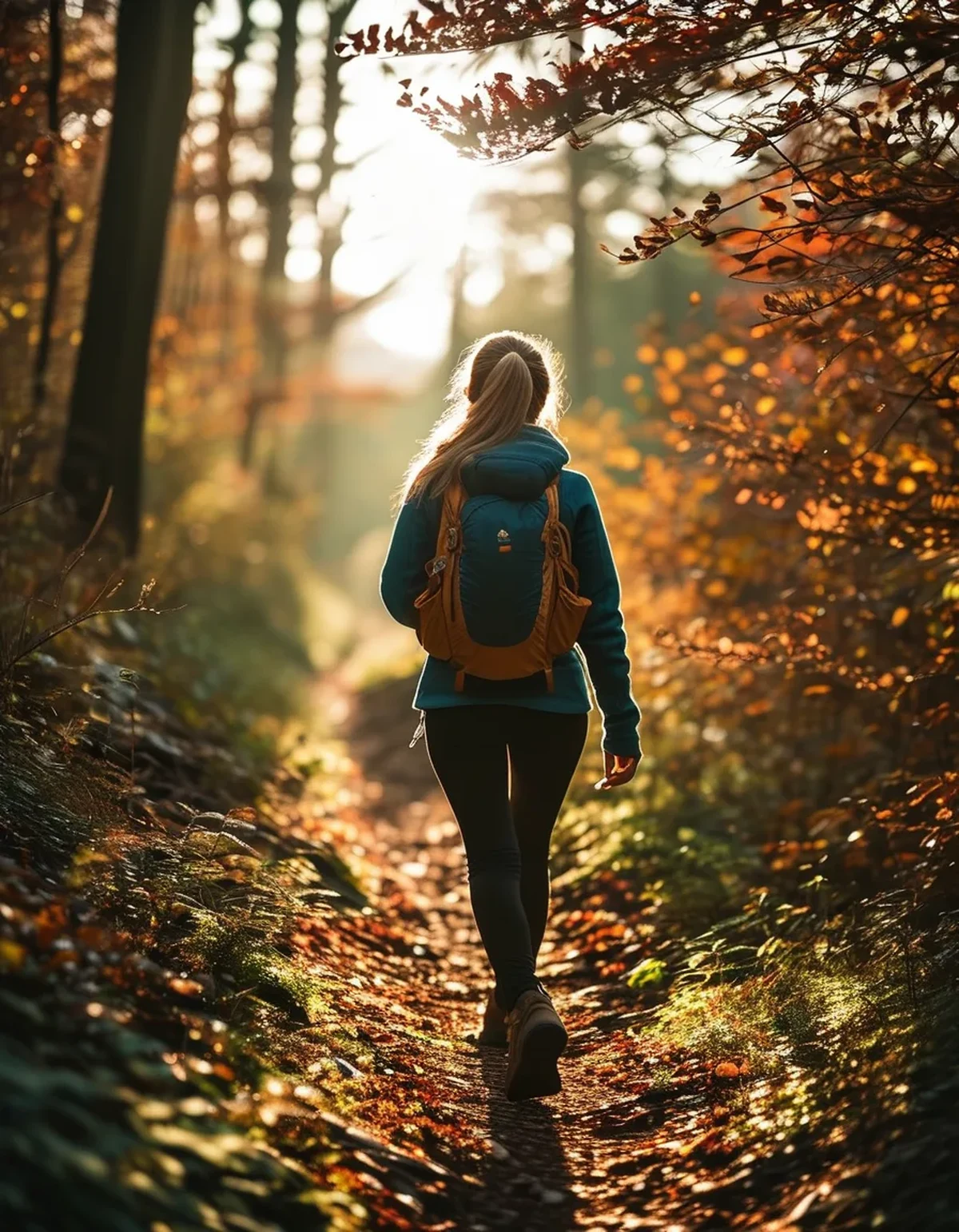
Legs need thinking about too. Quick-drying trousers or leggings that hold their shape when wet, not cotton. Leggings that stay put when you scramble and do not sag when wet are a practical safety consideration on a long descent, not just a comfort one — soaked, sagging fabric is cold and restricts stride.
The principle underneath all of it: adjust before you need to. Add a layer at the start of a climb into wind rather than after you are cold, and remove one before you sweat through your base layer.

What about footwear and the descent?
The descent is where autumn injuries happen, and footwear is most of the answer.
Tread depth matters more than boot stiffness. On wet leaves and mud, aggressive lugs with good spacing clear debris and grip. Worn-smooth soles are the single most common cause of autumn slips, and people keep wearing boots long past the point the tread has gone.
Check your soles before the season. If the lugs are rounded or shallow, resole or replace. This is a five-second check that prevents a very common injury.
Waterproof boots are worth it now. Summer’s fast-drying trail shoes make sense in dry conditions. In autumn, wet feet all day in cool air is both miserable and a genuine cold risk on a long day.
Descend with shorter steps and a lower centre of gravity. Long strides downhill on wet leaves is how people go over. Shorter steps, knees softer, weight slightly back over the heels on steep wet ground.
Poles genuinely help on descent. They reduce load on the knees measurably and provide two extra points of contact on slippery ground. Autumn is the season where they earn their place most clearly.
Watch the shaded sections specifically. North-facing and tree-shaded ground stays wet and freezes first. The same trail can be perfectly grippy in the sun and treacherous fifty metres later in shade.
What should be in the pack?
Six items that are optional in summer and not in autumn.
A head torch, always, with fresh batteries. Even for a walk you expect to finish at 3pm. Autumn plans slip, dusk arrives fast, and a phone torch drains the battery you may need for navigation or a call. This is the single most important seasonal addition.
More food than you need, including something for a cold stop. Cold weather increases energy demand, and a bad situation is much more manageable with food.
A hot drink in a flask. Practical and morale-changing in a way that is easy to dismiss until you have stopped in the wind for lunch.
Map and compass, not only a phone. Cold drains phone batteries much faster, and autumn is when people discover this at the worst moment. Carry a paper backup and know how to use it.
A small first aid kit with a foil blanket. Ankle injuries on wet leaves are the most common autumn incident, and an injured person stops generating heat immediately.
A dry bag for the spare layer. A spare insulating layer that has got wet in your pack is not a spare layer. This is a small detail that decides whether the safety margin actually exists. This is general information, not professional mountain safety instruction — in mountainous terrain, get proper training and check local conditions.
What about the specific autumn hazards?
Six things that are genuinely different this time of year.
Wet leaves over roots and rock. Low friction, and they hide what is underneath. Treat leaf-covered rock as if it were ice, particularly on descent.
Early frost and black ice on high ground. Ground can be frozen on a shaded ridge while the valley is merely damp. Ice on rock is very hard to see and unforgiving.
River and stream levels rise. Autumn rain raises crossings that were trivial in summer. Never cross fast-moving water above knee height, and turn back rather than risk it — this is a genuinely serious hazard.
Fewer people on the trail. Help is further away and less likely to pass. This changes the risk calculation on solo walks meaningfully.
Hunting seasons in some regions. Where relevant, wear bright colours and check local information. Worth five minutes of research for an unfamiliar area.
Deer rut in some regions during autumn. Large animals behave differently in rutting season, and keeping distance from deer and dogs on leads matters more than usual.
And the mushroom-and-berry temptation. Autumn brings foraging opportunities and misidentification risk. Do not eat anything you cannot identify with certainty — several dangerous species look very like edible ones, and autumn is when poisoning cases peak.
One more that catches experienced walkers: mist and low cloud. Autumn mornings produce valley fog and hill cloud far more often than summer ones, and visibility on a familiar ridge can drop to a few metres within minutes. Navigation that relied on seeing the next landmark stops working entirely, which is the practical reason the paper map and compass are on the packing list rather than a nice-to-have. If cloud comes in and you are not confident navigating in it, turn back along ground you have already walked rather than continuing to a summit you cannot see. Descending a route you know beats finding a new one blind, every time.
FAQ: Autumn Hiking Questions, Answered
How much earlier does it get dark?
Roughly two to three minutes a day through September and October — more than an hour per fortnight. Check today’s sunset time rather than relying on memory.
What is a safe turnaround time?
At least 90 minutes before sunset, set before you start and honoured regardless of how close the summit looks.
What is the most important thing to pack?
A head torch with fresh batteries, even for a walk you expect to finish in daylight.
How should I layer?
Synthetic or merino base (never cotton), removable fleece mid layer, waterproof windproof shell, plus a spare insulated layer kept dry in the pack.
Why are wet leaves so dangerous?
They have very low friction over rock and roots, and they hide what is underneath. Treat leaf-covered rock like ice, especially descending.
How much longer will a route take?
Add 20-30 percent over your summer time on the same route for soft ground and slower descents.
Are poles worth carrying?
In autumn, clearly yes. They reduce knee load and give two extra contact points on wet descents, which is where most injuries happen.
Can I rely on my phone for navigation?
No. Cold drains batteries fast. Carry a paper map and compass and know how to use them.
TL;DR:
- Daylight shrinks two to three minutes a day — set a hard turnaround 90 minutes before sunset.
- Use a layering system, not one coat: merino or synthetic base, removable mid, waterproof shell, spare insulation kept dry.
- Wet leaves are the season’s main hazard — treat leaf-covered rock like ice and shorten your steps descending.
- Check your boot tread before the season, and carry poles for the descent.
- Head torch, paper map, extra food, foil blanket — all non-optional now.
- Budget 20-30 percent more time than the same route took in summer.
Before your next walk, look up today’s actual sunset time and write your turnaround time on your hand. It is the simplest safety measure in autumn hiking.
See It in Motion
Seen here: Super High Waist Embossed Yoga Leggings with Inner Pocket — shop it on bubblelime.com
Keep Reading
This article is for general informational and styling purposes only. Fit, sizing, and product availability may vary — check current details before purchasing.