The Complete Guide to Choosing a Water Filtration System for Serious Trail Time
Quick Answer: The right water filtration system depends on group size, trip length, and water source clarity — squeeze filters suit solo fast-and-light trips, pump filters handle group camps and murky water better, and UV or chemical treatment work best as lightweight backups rather than primary systems for extended trips.
Choosing a water filter feels like it should be simple until you’re staring at a wall of options — squeeze, pump, gravity, UV, chemical — each claiming to be the best. The right choice actually depends on very specific details about how and where you hike.
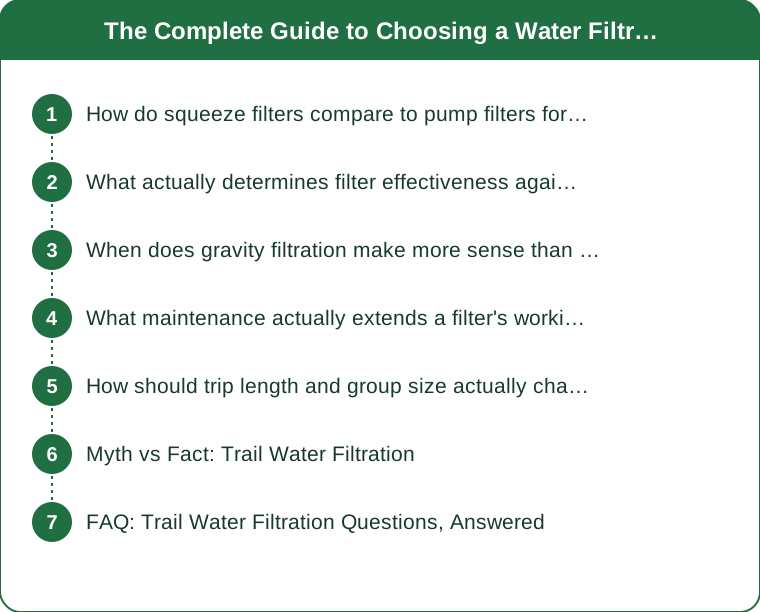
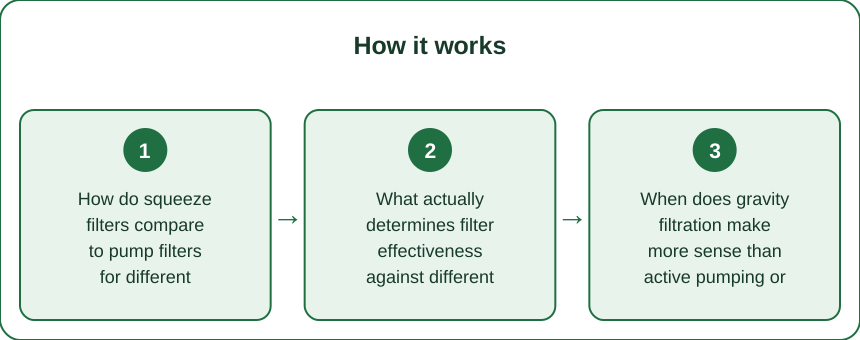
How do squeeze filters compare to pump filters for different trip types?
Squeeze filters (like hollow-fiber straw-and-bag systems) are lightweight and fast for solo or duo trips with relatively clear water sources — you fill a soft bottle, squeeze water through the filter, and drink, with minimal setup time. Pump filters take more effort per use but handle silty or murky water more reliably and can filter larger volumes efficiently for group camps, since one person can filter for the whole group at a water source rather than everyone individually treating their own water.
The tradeoff is weight and packability — squeeze systems typically weigh 2-4 ounces, while pump systems often run 8-16 ounces including the pump mechanism, which matters more on long through-hikes where every ounce compounds over miles.
What actually determines filter effectiveness against different contaminants?
Filtration is rated by pore size in microns — most hollow-fiber filters remove bacteria and protozoa (like Giardia) effectively at 0.1-0.2 microns, but standard filters do not remove viruses, which are smaller than bacteria. In regions with potential viral contamination (often more of a concern internationally than in most US backcountry), a filter alone isn’t sufficient and should be paired with UV treatment or chemical purification (iodine or chlorine dioxide tablets) as a supplementary step.
Understanding this distinction matters because marketing language can blur it — ‘purifier’ technically implies virus removal capability while ‘filter’ often does not, so reading the specific microbiological claims matters more than the general product category name.
When does gravity filtration make more sense than active pumping or squeezing?
Gravity systems, where you hang a bag of water and let gravity push it through a filter into a clean reservoir, excel at basecamp scenarios where you’re filtering a large volume (multiple liters) for a group without wanting to actively pump or squeeze repeatedly. The tradeoff is that they require a hanging point and take passive time, so they’re less ideal for quick water grabs during active hiking versus at an established camp for the night.
Many serious trail users actually carry a combination — a fast squeeze filter for on-trail refills and a gravity system for basecamp needs — rather than expecting one system to excel at both use cases.
What maintenance actually extends a filter’s working life on a long trip?
Backflushing after each use (running clean water backward through the filter, which most hollow-fiber systems support with an included syringe) clears trapped sediment that would otherwise reduce flow rate over the trip. Never let a filter freeze with water still inside it — ice expansion can crack the hollow fibers invisibly, causing the filter to pass contaminants without any visible sign of damage, which is a serious and under-discussed risk for shoulder-season and winter trail use.
Storing a filter dry, backflushed, and protected from freezing between trips extends its effective lifespan significantly beyond just following the stated liter capacity on the packaging.
How should trip length and group size actually change your filter choice?
For solo weekend trips with clear water sources, a squeeze filter is usually sufficient and lightest. For groups of 3 or more on multi-day trips, a pump or gravity system reduces the total time spent on water logistics across the whole group, even though it weighs more per person when shared. For international trips or areas with known viral contamination risk, pairing any filter with a UV pen or chemical tablets closes the coverage gap that filtration alone leaves open.
The honest answer is that there’s no single best system — the right choice is a direct function of your specific trip’s water sources, group size, and season, which is why experienced trail users often own more than one type and choose based on the trip rather than defaulting to the same gear every time.
Myth vs Fact: Trail Water Filtration
Myth: Any filter removes all waterborne pathogens. Fact: Standard filters remove bacteria and protozoa but not viruses — read the specific microbiological claims, not just the word ‘filter’ or ‘purifier.’ Myth: A more expensive filter is always the better choice. Fact: The right filter is the one matched to your specific water sources and trip type — an ultralight squeeze filter can outperform a heavier pump system for the right use case, and vice versa.
FAQ: Trail Water Filtration Questions, Answered
Do I need to filter water from a fast-moving mountain stream if it looks clean?
Yes — clarity doesn’t indicate microbiological safety; upstream animal activity can contaminate even the clearest-looking water, so filtering remains necessary regardless of appearance.
How often should a filter be replaced rather than just cleaned?
Most hollow-fiber filters are rated for a specific liter capacity (often 1,000+ liters) before flow rate degrades meaningfully even with proper backflushing — track usage roughly and replace once flow becomes noticeably slow despite cleaning.
Is boiling water a reasonable backup if a filter fails on trail?
Yes — boiling for one minute (three minutes above 6,500 feet elevation) is a reliable backup method that requires no special equipment beyond what most backpackers already carry for cooking.
TL;DR:
- Squeeze filters suit solo, fast, clear-water trips; pump and gravity systems suit groups and murkier water
- Standard filters remove bacteria and protozoa but not viruses — check the specific claims
- Backflush after each use and never let a filter freeze with water inside
- Match your system to trip length, group size, and region rather than picking one default The right filter isn’t about the biggest name brand — it’s about matching the tool to your actual water sources and trip style, and many serious hikers carry more than one system for exactly that reason.
Keep Reading
This article is for general informational and styling purposes only. Fit, sizing, and product availability may vary — check current details before purchasing.