Why Early Fall Day Hikes Go Wrong More Often Than Summer Ones
Quick Answer: Four things change between August and October and each one is easy to underestimate individually: daylight shortens by roughly two to three minutes per day, the temperature spread between midday and evening widens dramatically, leaf cover hides trail markers and uneven ground, and warm afternoons make people carry less water than a cool day actually requires. None of these is dangerous alone. Together they turn a familiar summer route into a hike that finishes in the dark, colder than expected, on a trail you can no longer see clearly.
You have done this trail four times this year.
Which is exactly why you left an hour later than you should have, and why the last mile happened by phone torch.
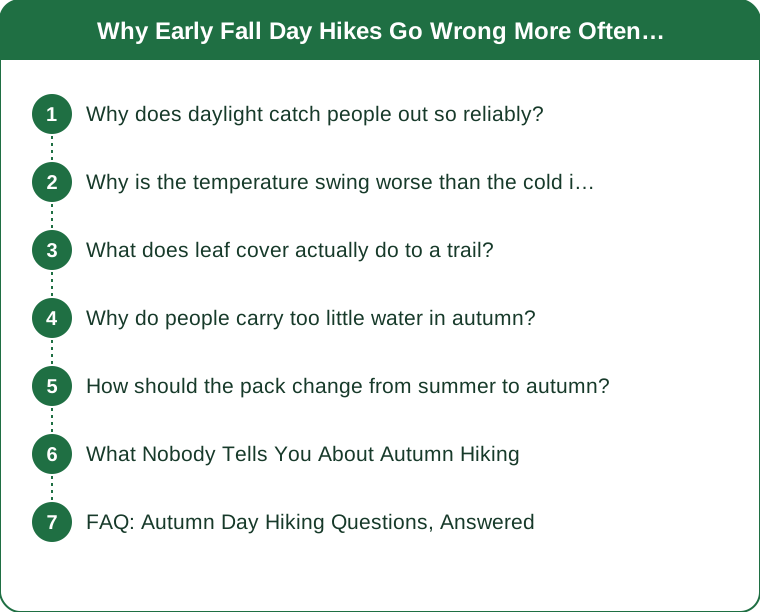
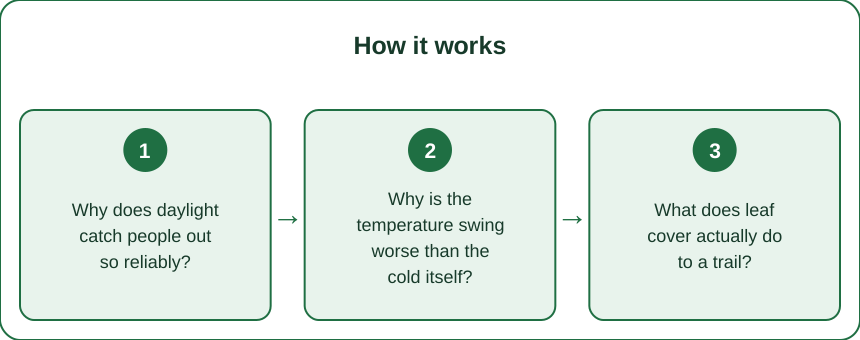
Why does daylight catch people out so reliably?
The rate of change is the problem, not the total. In September and early October, mid-latitude locations lose roughly two to three minutes of daylight per day, which compounds to more than twenty minutes a week.
Your mental model is built on the last time you did the route, and if that was three weeks ago, sunset arrives nearly an hour earlier than your memory says.
Useful light ends well before sunset on a wooded trail. Under tree cover, particularly in a valley or on an east-facing slope, practical visibility can fade thirty to forty-five minutes before the official sunset time.
Low sun angle makes it worse in a way that surprises people. Even an hour before sunset, autumn light comes in almost horizontally, which produces long shadows across the trail and periods of direct glare when the trail turns west. Both make footing genuinely harder to read.
Autumn hikes also start later. The mornings are cold and dark, the coffee takes longer, and the departure that would have been 7am in July becomes 9:30am in October without anyone deciding it should.
And the pace assumption is usually wrong too. Leaf-covered ground, wet roots and a cooler body all slow the return leg, so the hike takes longer at exactly the point where less light remains.
The fix is arithmetic, not equipment: look up the actual sunset time for the date rather than trusting your memory of it, subtract 45 minutes for tree cover, subtract another 30 as a margin, and work backwards to a turnaround time you commit to before you start. Then carry a real headtorch regardless, because the whole point of a margin is that it occasionally gets used.
Why is the temperature swing worse than the cold itself?
Autumn has the widest daily temperature spread of the year in many regions, frequently 20 to 30 degrees Fahrenheit between the afternoon high and the evening, and more at elevation.
You dress for the moment you leave the car, which is usually the warmest part of the day and the least representative of the conditions you will finish in.
Sweat becomes a genuine liability rather than a nuisance. A base layer soaked on a warm climb is a cooling system you cannot switch off once you stop moving or the sun drops, and evaporative cooling from wet fabric can drop skin temperature fast.
Wind matters more once the leaves start thinning, and exposed ridges that felt sheltered in August have a noticeably different character in October.
Elevation multiplies everything. Temperature falls roughly 3 to 5 degrees Fahrenheit per thousand feet of gain, so a summit is meaningfully colder than the trailhead even before the evening arrives.
The people who get cold are rarely the ones who brought no layers - they are the ones who brought layers and did not stop to use them, because stopping feels like losing time and putting a jacket on while warm feels unnecessary.
Practical version: wear less than feels right at the trailhead so you sweat less on the climb, carry a wind shell and one insulating layer regardless of the forecast, choose a base layer in merino or synthetic rather than cotton, and put the insulating layer on at the summit before you cool down rather than after. A hat and thin gloves weigh almost nothing and cover the two places heat leaves fastest.
What does leaf cover actually do to a trail?
It hides the trail surface completely. Rocks, roots, holes and drop-offs that were visible in August are under an even blanket that gives no information about what is beneath it.
Ankle injuries rise in autumn for exactly this reason. A foot lands expecting flat ground and finds a rock edge, at a moment when the ankle is not braced for it.
Wet leaves on rock or a boardwalk are genuinely slippery, comparable to ice in the worst cases, and they are most common on the shaded descents where people are already moving fastest.
Trail markers disappear at ground level. Cairns get buried, painted blazes on low rocks vanish, and worn-path visibility - the thing most people actually navigate by without noticing - stops working entirely once the ground is uniformly covered.
Junctions become the specific risk. A faint side trail and the main trail look identical under leaves, and this is where most autumn navigation errors start.
Leaf cover also makes distance harder to judge, because the visual cues you use to track progress are gone and the landscape looks more uniform than it did.
What helps: download the offline map before you leave signal rather than assuming coverage, check your position at every junction rather than only when confused, slow the descent deliberately, use trekking poles for the extra points of contact on hidden ground, and choose footwear with real ankle support and an aggressive outsole rather than the trail runners that were fine on dry summer dirt.
Why do people carry too little water in autumn?
Thirst signalling weakens in cool air. You do not feel thirsty at 55F the way you do at 85F, and thirst was already a lagging indicator of hydration.
Sweat is less visible. In dry autumn air it evaporates before it accumulates, so you do not see or feel the fluid you are losing, and the internal evidence that drives drinking simply is not there.
Respiratory losses go up in cold dry air. You lose meaningful fluid through breathing alone, and the colder and drier the air, the more of it.
Cool-weather hiking is often harder work, because people move faster when they are not overheating, so the actual output can exceed a summer hike on the same trail.
Nobody stops to drink when they are not hot, and the pause that happens naturally in summer heat never occurs.
Seasonal water sources also become less reliable, and streams that ran in June may be dry in early autumn, which turns a planned refill into a problem.
Realistic guidance: carry roughly half a litre per hour of hiking as a baseline and more with elevation, drink on a schedule rather than by thirst - every 20 to 30 minutes is a workable rule - and add electrolytes on anything over about two hours, since cool-weather sweat still carries salt out. Carry the full amount if you are not certain a source will be running, and treat any water you do collect.
How should the pack change from summer to autumn?
Add a headtorch, permanently, from September onward. Not a phone torch - a real headtorch with fresh batteries and hands free. This is the single highest-value item on the autumn list.
Add a wind shell, which weighs very little and does more for warmth per gram than any insulating layer, because wind is what makes autumn evenings bite.
Add one insulating layer beyond what you think you need, a light down or synthetic jacket that lives in the pack all season and comes out at the summit.
Add a hat and thin gloves, which are trivial in weight and disproportionate in effect once the temperature drops.
Swap the trail runners for boots with ankle support on leaf-covered ground, or at minimum choose the more aggressive outsole in your rack.
Add an offline map on the phone and a battery pack, since cold weather reduces phone battery life significantly and navigation is exactly when you need it.
Add more food than the distance suggests. Cold weather raises energy demand and a hike that runs long in the dark is far more manageable on a full stomach.
And carry a small emergency layer - a foil blanket weighs almost nothing and turns a bad situation into an uncomfortable one.
Take out the extra sun gear if you like, though a low autumn sun straight into your eyes on a westward trail is its own argument for keeping sunglasses in the pack.
What Nobody Tells You About Autumn Hiking
Your summer fitness is misleading in a specific way. You are objectively fitter in September than you were in May, which raises confidence about distance and pace. But autumn hiking is not limited by fitness - it is limited by daylight, temperature and footing. The fittest hiker on the trail still finishes in the dark if they left at 10am, and being fit makes the too-ambitious route feel reasonable right up until the light goes.
The most dangerous hour is the one after you decide to push on. Almost every autumn hiking story turns on a moment where someone reached a planned turnaround, felt fine, and continued. The decision is made while warm, well lit and comfortable, and it is paid for ninety minutes later in the cold and the dark. Setting a turnaround time in advance and treating it as non-negotiable removes the decision from the moment you are least equipped to make it.
Descents cause more autumn problems than climbs. The climb happens in the warmest, brightest part of the day with the best footing. The descent happens later, on cooling legs, in fading light, on wet leaves, moving fast. Plan the descent as the harder half, and add time to it rather than assuming it will be quicker.
Cold makes decisions worse before it makes you cold. Mild hypothermia degrades judgment noticeably before shivering becomes obvious, which is why people who get into trouble often report making a series of choices that made no sense afterwards. If someone in the group gets quiet, clumsy or unusually agreeable, that is the signal to add layers and food immediately.
Trail popularity drops off sharply after the leaf-peak weekend. Routes that were busy in early October can be genuinely empty two weeks later, which is lovely and which also means far fewer people to notice a problem. Telling someone your route and expected return time matters more in November than it did in July.
And phone batteries fail faster than anyone plans for. Cold reduces lithium battery capacity substantially, and a phone at 40 percent in a cold outer pocket can shut down without warning. Carry it in an inside pocket close to your body, and bring a battery pack - the phone is your map, your torch backup and your call for help, and it is the item most affected by the season.
FAQ: Autumn Day Hiking Questions, Answered
How much earlier should I start in October compared to July?
Work it backwards from the actual sunset rather than by feel. In many mid-latitude locations, sunset in mid-October is roughly two hours earlier than in mid-July, so the start should move by at least that much.
Are trail runners fine for autumn trails?
On dry, clear trails yes. Once leaf cover is hiding rocks and roots, boots with ankle support and a more aggressive outsole are a meaningful reduction in ankle injury risk.
How much water for a four-hour autumn hike?
Roughly two litres as a starting point, more with significant elevation gain, and do not rely on seasonal streams being flowing.
What is the single most important item to add?
A headtorch. It converts the most common autumn hiking problem - finishing in the dark - from a serious situation into an inconvenience.
How do I avoid getting cold at the summit?
Put the insulating layer on as you arrive, before you cool down, and eat something. Waiting until you feel cold means warming a body that has already lost heat.
Is it worth carrying trekking poles?
On leaf-covered descents, yes. Two extra points of contact on ground you cannot read is exactly the situation they are best at.
How do I tell if someone in the group is getting too cold?
Watch behaviour rather than complaints - quietness, stumbling, fumbling with zips or unusual passivity. Add layers, add food, and shorten the day.
This is general information, not medical advice.
TL;DR:
- Four variables change at once: daylight, temperature spread, leaf-covered footing and quiet dehydration.
- Look up the real sunset, subtract 45 minutes for tree cover and 30 for margin, and set a turnaround time before you start.
- Dress lighter for the climb, carry a wind shell plus one insulating layer, and put it on at the summit before cooling down.
- Leaves hide rocks, roots and trail markers - slow the descent, use poles, check the map at every junction.
- Drink on a schedule, not by thirst, and add a headtorch, gloves, hat, battery pack and extra food to the autumn pack.
The trail did not get harder. The margins got thinner.
Keep Reading
This article is for general informational and styling purposes only. Fit, sizing, and product availability may vary — check current details before purchasing.