Why Experienced Hikers Carry Less Water Than Beginners and Run Out Less Often
Quick Answer: Experienced hikers plan around water sources rather than carrying a day’s supply. Water weighs 2.2 pounds per liter, and carrying four liters costs nearly nine pounds of pack weight that slows you down and increases your own water demand. Source planning plus a filter usually beats volume.
You watch someone start a twelve-mile day with a single liter and assume they are underprepared.
Six hours later they have drunk five liters, filtered three times, and finished comfortably. You carried four from the trailhead, ran dry at mile nine, and hiked the last three thirsty.
This is not a fitness difference. It is a different planning model, and it is learnable in an afternoon.
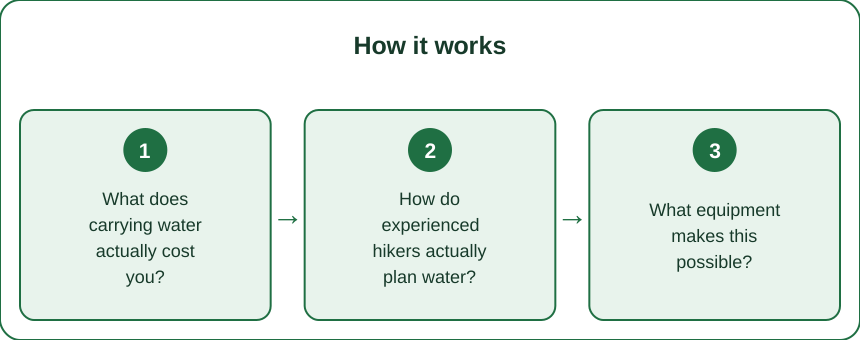
What does carrying water actually cost you?
Water weighs 2.2 pounds per liter, and it is the densest thing most hikers carry. Four liters is 8.8 pounds — often more than tent, sleeping bag, and stove combined on a day hike.
That weight has compounding costs. Research on load carriage consistently finds that added pack weight increases metabolic cost of walking, with rough estimates around a 1 percent increase in energy expenditure per 1 percent of body weight added. For a 150-pound hiker, nine pounds of water is roughly 6 percent of body weight and a meaningful energy penalty.
More energy expenditure means more heat production, which means more sweating, which means more water needed. Carrying extra water measurably increases the amount of water you need. That feedback loop is the part beginners never see.
There is a pace cost too. A heavier pack slows you by a noticeable margin on climbs, which extends your time on trail, which extends your exposure to heat and increases total demand again. The four liters you carried to be safe have quietly made the day longer, hotter, and thirstier.
None of this argues for carrying too little. It argues that volume is a blunt instrument and that the experienced hiker is solving the problem with information instead of mass.
How do experienced hikers actually plan water?
They plan between sources, not for the whole day. The question is never how much water do I need today. It is how much do I need to reach the next reliable source.
The process before a hike looks like this. First, identify every water source on the route using a topographic map, a trail app with user reports, and recent trip reports. Streams, springs, lakes, and in some regions seasonal tanks and troughs.
Second, note the longest dry stretch between consecutive reliable sources. That single number determines your carry capacity, not the total distance.
Third, apply a consumption rate. A common working figure is 0.5 liters per hour in moderate conditions and 1 liter per hour in heat or on sustained climbs. Multiply by the hours in the longest dry stretch, then add a margin of 0.5 to 1 liter.
Fourth, verify recency. A spring marked on a 2015 map may be dry in late summer. Trip reports from the current season are the single most valuable data source available, and this is where the real skill lives — not in the arithmetic, but in knowing which sources to trust.
The result on a typical summer day hike with a source every three or four miles is a carry of 1.5 to 2 liters, refilled two or three times. Same total consumption, a third of the peak weight.
What equipment makes this possible?
The planning model depends on being able to use what you find, which means filtration. This is the enabling technology, and it is light and cheap now in a way it was not twenty years ago.
Squeeze filters are the dominant choice for day hiking. They weigh 2 to 3 ounces, cost $25 to $45, filter at roughly a liter per minute, and remove bacteria and protozoa — which covers the realistic risks in most North American backcountry water.
Chemical treatment — chlorine dioxide tablets or drops — weighs almost nothing and serves as a backup. The tradeoff is a 30 minute wait, up to 4 hours for full protection against some organisms, and a slight taste. Carry a few tablets regardless of your main system; filters clog and freeze.
UV pens work well in clear water, need batteries, and are ineffective in silty water without pre-filtering.
Boiling is the fallback that always works and costs fuel and time.
What filters generally do not remove is viruses and chemical contamination. Viruses are a minor concern in remote North American backcountry and a real one in areas with heavy human traffic or agricultural runoff. Below mines, agricultural land, or heavy grazing, filtration does not address dissolved contaminants at all — the answer there is to choose a different source, not a better filter.
What Nobody Tells You About Reading Water Sources
Maps mark where water was. They do not tell you whether it is there today, and that gap is where beginners get into trouble following an experienced hiker’s methods without an experienced hiker’s judgment.
Here is what actually gets read on the ground. Flowing beats standing, always. Moving water is better oxygenated and far less likely to concentrate contaminants. A trickle you have to work at is a better source than a still pool ten feet away.
Look uphill before you fill. What is above this point? A trail crossing, a campsite, a grazing meadow, a mine tailing? Water quality is determined by the watershed above the collection point, and moving 200 yards upstream of a trail crossing costs five minutes and removes the most common contamination source there is.
Springs beat streams. Water emerging from the ground has been filtered by the ground. If a source is marked as a spring and you can collect at the emergence point, that is the best water on the mountain.
Seasonality is everything in late summer. By August and September, sources that ran reliably in June are frequently dry. This is the single most common failure mode, and it is why current-season trip reports outrank every other information source.
And the thing nobody says out loud: experienced hikers carry less because they are willing to turn around. The confidence to run a lean water plan comes partly from a genuine willingness to abort if a source is dry. A beginner carrying four liters has no plan for a dry source either — they just delayed the problem to mile nine.
How much do you actually need to drink?
Consumption varies enormously, and the honest answer is that you should calibrate against yourself rather than a chart.
Commonly cited working figures are 0.5 liters per hour in mild conditions at moderate effort, rising to 0.75 to 1 liter per hour in heat, at altitude, or on sustained climbing. A hiker at 200 pounds moving fast in 90-degree heat may exceed that; a light hiker strolling in 60-degree forest may need half.
The most useful individual calibration is straightforward. On a familiar hike, weigh yourself before and after, note exactly how much you drank, and the difference approximates your sweat rate for those conditions. Do it twice, in different weather, and you will have a personal number more accurate than any general guideline.
Electrolytes matter above roughly two hours of sustained sweating, and more so in heat. Drinking large volumes of plain water while losing significant sodium can produce hyponatremia, which is rare but genuinely dangerous and disproportionately affects people who diligently over-drink. A tablet or a salty snack per liter in hot conditions addresses it.
Practical monitoring on trail: urine color pale straw rather than clear or dark, and drinking to thirst plus a little rather than on a rigid schedule. Thirst is a reasonably good guide for most people under most conditions, and better than a number you decided on at the trailhead.
When should you ignore all of this and just carry more?
The lean model has clear boundaries, and knowing them is what makes it safe rather than reckless.
Carry the full day’s water when sources are unverified. A new-to-you trail with no recent reports is not the place to run a lean plan.
Carry more in desert and arid terrain. Where sources are 15 miles apart and seasonal, the calculus reverses entirely. Desert hiking is the one context where carrying six or more liters is normal practice, and where the failure mode is severe.
Carry more in late season. August through October in most of North America is when marked sources are least reliable. This is exactly the season we are in now, and it is worth adding a liter of margin to any plan built on spring conditions.
Carry more when you are responsible for others. Hiking with children or a group that includes people who may not self-monitor means carrying the margin for them.
Carry more when the consequence of running out is high — a remote route, no cell coverage, a long exit, or extreme heat.
The underlying principle is not carry less. It is match the carry to the information you actually have. When information is good, the carry can be light. When it is not, weight is the substitute for knowledge, and that is a perfectly reasonable trade to make.
This is general information, not medical or safety advice. Heat illness and dehydration are serious; if you are new to a region or a distance, err toward carrying more while you build local knowledge.
FAQ: Trail Water Questions, Answered
Is a hydration bladder better than bottles?
Bladders encourage steady sipping and are easier to drink from while moving. Bottles are easier to fill, easier to monitor, and far easier to treat chemically. Many experienced hikers carry both — a bladder for the main supply and a bottle for filtering into and for electrolyte mix.
How do I know if a filter is still working?
Squeeze filters slow down as they clog; a filter that has become hard to push water through needs backflushing. Most have a rated capacity in the thousands of liters, but real-world life depends heavily on water clarity. Replace it if it has ever frozen with water inside — freezing can crack the fibers invisibly.
Can I drink from an alpine stream without treating it?
Many people do and most are fine, but the risk is not zero even at altitude — giardia is present in backcountry water across most of North America. A 2-ounce filter removes the question entirely for $30, which is a very cheap resolution to an uncertain risk.
What is the fastest way to filter a lot of water?
Gravity systems. A hanging bag filtering into a reservoir handles 4 to 6 liters unattended while you rest or set up camp. For groups, this is dramatically faster than everyone squeezing individually.
How much margin should I add to a calculated need?
A reasonable default is 0.5 liters on a short day and 1 liter on a long or remote one, on top of your calculated dry-stretch requirement. That margin is what turns a dry source from an emergency into an inconvenience.
TL;DR:
- Water is 2.2 lb per liter, and carrying it increases your energy cost, heat production, and therefore your water need.
- Plan around the longest dry stretch between verified sources, not around total distance.
- A 2–3 oz squeeze filter plus a few chemical tablets makes a 1.5–2 liter carry viable on most summer day hikes.
- Reverse all of it for desert terrain, unverified routes, late-season dry sources, or group responsibility.
The hiker with one bottle is not gambling. They have replaced weight with information — and in late summer, when the sources you counted on in June may be gone, the information half of that trade is the part worth doing carefully.
Keep Reading
This article is for general informational and styling purposes only. Fit, sizing, and product availability may vary — check current details before purchasing.